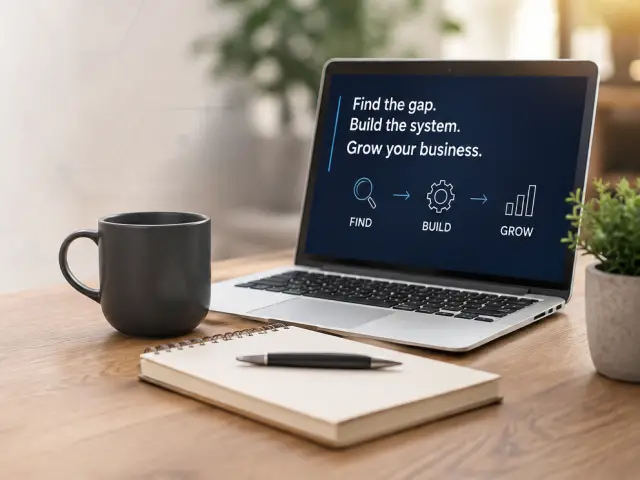

Local service businesses in South Africa turn more online interest into paying customers when four things work together: they are easy to find locally, their website and Google Business Profile answer the questions a buyer has, every enquiry is captured and answered quickly, and a simple follow-up routine keeps promising customers from going quiet. Advertising and search visibility bring people to the door. A clear, repeatable process decides how many of them walk through it. This guide explains how that process works for clinics, dentists, salons, guest houses, restaurants, professional firms, builders and consultants, and gives you a 30-day plan you can start with the tools you already have.
What “marketing for a local service business” actually involves
Marketing for a local service business is the set of activities that help nearby customers find you, trust you and contact you, followed by the routine that turns that contact into a booking, appointment or signed quote. It is not only advertising. It has five parts, and each one can be strong or weak on its own:
- Visibility: appearing when someone searches for what you do in your area, on Google, Bing, maps and social platforms.
- Trust: reviews, clear information, real photographs, professional wording and consistent details.
- Contact: an obvious, easy way to enquire by phone, WhatsApp, form or booking link.
- Response: how fast and how well you reply once someone makes contact.
- Follow-up: what happens after the first reply, until the customer books or says no.
Most owners spend their effort on the first part and assume the rest will look after itself. In practice, the last three are where the most avoidable losses happen, and they are also the cheapest to fix. Our guide to why getting more leads doesn’t fix a business that is losing customers covers that point in more detail.
Why more traffic is not the same as more customers
A common pattern in local businesses goes like this. The owner pays for ads or invests in a new website, enquiries rise, and yet the diary does not fill in proportion. The reasons are usually ordinary:
- Enquiries arrive on four channels and nobody owns the full list.
- Replies go out hours or days later, after the customer has already booked elsewhere.
- Quotes and price requests receive no second message.
- The website makes people hunt for a phone number or a booking option.
- Nobody tracks how many enquiries become customers, so the problem stays invisible.
None of these is a creative problem. They are process problems. That is good news, because a process can be written down, taught to staff and improved month by month. If you want a structured way to find your own gaps, our article on seven customer journey gaps that could be costing your business customers is a good place to start.
Step 1: Be easy to find in your area
Claim and complete your Google Business Profile
Your Google Business Profile is often the first thing a local customer sees: your name, rating, opening hours, phone number and photographs, sometimes before they ever reach your website. A complete profile typically includes:
- The correct business name, address or service area, phone number and website, written the same way everywhere they appear online.
- A primary category that matches your main service, plus accurate secondary categories.
- Opening hours, including public holiday changes.
- A short, plain description of what you offer and who you serve.
- Services or products listed with brief descriptions.
- Recent, genuine photographs of your premises, team and work, rather than stock images.
- A booking, WhatsApp or enquiry link where the platform allows it.
Treat it as a living page. Update hours when they change, add photographs regularly and respond to questions and reviews. Bing Places and similar directories are worth claiming too, because they feed other search tools and map services, and many South African businesses have never claimed them.
Make your service area and services explicit
Search engines and customers both need to understand what you do and where. A practice in Benoni that treats patients from nearby suburbs should say so on its website. A contractor who works across Gauteng should list the areas served. Write service pages in natural language: what the service is, who it suits, what happens first, what it generally involves and how to get in touch. Avoid long lists of suburb names with no useful content behind them, because they read as filler to people and to search engines.
Keep your details consistent
Name, address and phone number should match across your website, Google Business Profile, social pages and any directory listings. Small differences, such as an old phone number on a directory, create confusion for customers and can weaken trust in the listing. A quick audit of where your business appears online takes an afternoon and prevents months of confusion.
Step 2: Build a website that answers a buyer’s questions
A local service website does not need to be large. It needs to answer, quickly and clearly, the questions a nervous first-time customer is asking. Whether the business is a dental practice, a guest house or an accounting firm, those questions are remarkably similar:
- What exactly do you do, and is it right for my situation?
- Where are you, and when are you open?
- Roughly what does it cost, or how is pricing worked out?
- What happens when I make contact?
- Can I see proof that you are professional and trustworthy?
- How do I book or ask a question right now?
Put these answers where visitors look first. Place a clear call to action at the top of the page and repeat it at logical points further down. Make the phone number tappable on mobile. Keep forms short: name, contact detail and a line about what they need is usually enough for a first enquiry. Every extra field reduces the number of people who finish.
Think mobile first, and think slow connections
Most local searches happen on a phone, often while someone is out and about or on a mobile data connection that may be unreliable. Pages should load quickly, text should be readable without zooming and buttons should be large enough to tap. Compress images, avoid heavy sliders and test your own site on a phone, on mobile data, before you test it on an office computer.
Be honest about price and process
You do not have to publish a full price list, but a visible starting point, a pricing range or a clear explanation of how quotes work prevents wasted enquiries and builds confidence. People are more likely to contact you when they know what to expect.
Step 3: Give every visitor one obvious next step
Each page should have a primary action. For a clinic that may be “Book an appointment”, for a restaurant “Reserve a table”, for a lodge “Check availability”, for a law or accounting firm “Request a consultation”, for a builder “Request a quote”. Secondary options such as phone, WhatsApp and email should be easy to find but should not compete with the main action.
Match the wording of your call to action to the wording of whatever brought the visitor there. A person who clicked an advertisement for “dental implants consultation” should land on a page about implant consultations with a matching button, not on a generic home page. This message match is one of the most reliable ways to improve the quality of enquiries from paid search, and it also helps organic visitors understand quickly that they are in the right place.
Step 4: Capture every enquiry in one place
Enquiries arrive by phone, WhatsApp, email, web forms, social messages and walk-ins. If each channel is handled by a different person with a different habit, some enquiries are certain to be lost. A simple fix works for most small businesses:
- Keep one shared enquiry list, which can be a spreadsheet or a basic customer management tool.
- Record each enquiry with the date, name, contact details, what they want, source and status.
- Give every enquiry an owner, meaning one named person responsible for the next step.
- Update the status as it moves: new, contacted, quoted, booked, lost.
Add the source, such as “Google search”, “Facebook”, “referral” or “walk-in”. After a month you will know where your enquiries come from and which ones actually turn into customers. Our Business Growth Toolkit includes editable enquiry trackers and follow-up templates if you would rather start from a ready-made version.

WhatsApp deserves a process of its own
In South Africa many customers prefer WhatsApp to phone calls or email. That is useful, but it can quietly become a weak point when messages live on one person’s phone. Use the WhatsApp Business app where it suits you, set a greeting and away message, and keep quick replies for common questions. When a WhatsApp enquiry arrives, record it in the same list as every other enquiry so it receives the same follow-up as an emailed or phoned request.
Step 5: Set and keep a response-time standard
Speed signals reliability. A customer who contacts three businesses usually forms a first impression from whichever replies first and most helpfully. Decide what your standard is, write it down and measure it. Many businesses aim for an acknowledgement within a few minutes during working hours and a full answer within the same working day, but the right standard depends on your service. A funeral home must respond immediately and sensitively. A tax consultant may reasonably answer within hours.
An automatic acknowledgement can bridge the gap when nobody is free to reply personally. It should confirm that the message arrived, say when the customer will hear from a real person and tell them how to reach you urgently. Our guide on how quickly you should respond to a new enquiry walks through how to set a standard that fits your business.
Step 6: Follow up until the customer decides
Many customers who enquire do not book on the first reply. They compare options, check with a partner, wait for payday or simply get busy. A polite, planned follow-up is often the difference between a lost lead and a booked customer. A sensible rhythm for most services looks like this:
- Same day: acknowledge the enquiry and answer their main question.
- Two to three days later: check in, offer to answer further questions and make the next step easy.
- About a week later: share something useful, such as a short explanation, an availability update or a common question answered.
- Around two weeks later: close the loop politely, leaving the door open.
Stop as soon as the customer asks you to, and never send marketing messages to people who have not agreed to receive them. South Africa’s Protection of Personal Information Act (POPIA) and the rules on electronic direct marketing mean you should handle contact details carefully and respect opt-outs. If you are unsure, take advice from a qualified professional. For practical wording you can adapt, read our guides on booking follow-up, why customers go quiet after a quote and how to build a simple lead follow-up system.
Step 7: Earn and use reviews
Reviews help new customers decide, and they influence how prominently businesses appear in local results. Ask satisfied customers for a review at a natural moment, for example after a successful appointment, stay or completed job. Make it easy by sending a direct link, and never offer incentives that break platform rules. Reply to every review, positive or negative, in a calm and professional tone. A thoughtful reply to a critical review shows future customers how you handle problems.
Never fabricate or buy reviews. They are against platform policies, they can lead to penalties and customers can usually tell.
Step 8: Measure the numbers that matter
You do not need a complicated dashboard to improve. Track a few figures every month:
- Number of enquiries received, by channel.
- Number of enquiries that became bookings, appointments, quotes accepted or sales.
- Average time to first reply.
- Number of enquiries that never received a follow-up.
- Reasons customers gave for not proceeding.
The most useful of these is your enquiry-to-customer conversion rate: customers won divided by enquiries received. Our article on enquiry-to-booking conversion explains how to measure it and what to do when it is low. Be careful with small samples. A single month of ten enquiries tells you very little. Look at trends over a quarter.
How this plays out in different local industries
The principles above apply across sectors, but each industry has its own priorities and sensitivities.
Doctors, medical practices, dentists and physiotherapists
Patients look for reassurance, convenience and clarity. Show practitioner qualifications, consultation hours, the services offered and how to book. Make cancellations and rescheduling easy to reduce wasted appointment slots. Health professionals are bound by their regulatory councils’ rules on advertising, so check what your council permits before publishing claims, testimonials or before-and-after material. Patient information is sensitive: collect only what you need, store it securely and follow POPIA.
Beauty salons, spas and hair salons
Bookings, rebooking and no-shows drive revenue. A booking link, clear service and price information, and good photographs of real work matter more than clever slogans. Reminder messages the day before an appointment reduce no-shows, and a short check-in message after a treatment invites reviews and repeat bookings.
Guest houses, lodges, hotels and B&Bs
Travellers compare many options quickly, so photographs, location details, availability and a fast, helpful reply win bookings. Make direct enquiry and booking simple, answer common questions such as parking, check-in times and nearby attractions on the website and keep your Google Business Profile current. Respond to enquiries promptly, because guests often send the same message to several properties at once.
Restaurants and venues
Menus, opening hours, location and a reservation or event enquiry option should be visible within seconds on a phone. For functions and events, treat each enquiry like a quote request: capture the date, number of guests and requirements, and follow up until the customer confirms or declines.
Lawyers, attorneys, accountants and consultants
Clients buying professional services want clarity and credibility. Explain who you help, what a first consultation involves and what happens next. Use plain language rather than jargon. Professional bodies set rules about how their members may advertise, so confirm what is allowed before you publish claims or comparisons. A consistent, respectful follow-up routine matters here because decisions are often slower and involve more than one person.
Builders, civil and engineering businesses
Project enquiries need more detail before a price can be given. Use a short enquiry form that asks about the type of work, location, timing and budget range, then follow up with a clear next step such as a site visit. Keep a record of every quote sent and follow up on a schedule, as decisions in this sector can take weeks.
Funeral homes and undertakers
People contacting a funeral home are often in distress and need an immediate, compassionate response, clear information and simple next steps. Prioritise availability, a dignified tone and straightforward information about services. Automation has a limited role here, and any automatic message must be written with great care.

Where paid search fits
Paid search can be a sensible way to reach people who are already looking for a service, because the advertiser pays when someone clicks, and those clicks come from a specific search. It works best when the groundwork above is in place. Three principles help:
- Target buying intent. Keywords that include words such as “quote”, “prices”, “agency” or “services” tend to come from people closer to a decision than general informational searches.
- Send each advertisement to a matching page. The headline on the landing page should echo the promise in the advertisement.
- Track results beyond clicks. Count enquiries and customers, not only visits, so you can see which keywords and advertisements produce real business.
Advertising budgets are paid to the advertising platform and are separate from any service fee. Nobody can responsibly guarantee a specific number of enquiries or customers from advertising, so be wary of anyone who does. Results depend on your market, your offer, your pricing, your location and your response process.
A 30-day plan you can start this week
Week 1: Fix the foundations. Claim or complete your Google Business Profile and Bing Places listing. Check that your name, address and phone number match everywhere. Test your website on a phone and make sure the phone number and main call to action are obvious.
Week 2: Capture and respond. Set up a single shared enquiry list. Write your response-time standard. Create an acknowledgement message and quick replies for common questions. Name the person responsible for each channel.
Week 3: Follow up and ask for reviews. Write a four-message follow-up sequence using the rhythm above. Start asking recent happy customers for reviews. Respond to any reviews you have not yet answered.
Week 4: Measure and improve. Count enquiries, conversions and response times for the month. Identify your biggest leak, whether it is slow replies, no follow-up or a confusing website, and fix that one first.
What a complete growth system adds
The steps above can be done manually with a spreadsheet and some discipline. Many owners reach a point where that becomes hard to sustain, because enquiries multiply and staff time is limited. That is the point at which a connected system helps. Our Business Growth Automation System (BGAS) is designed to bring the pieces together for a local service business: a professional online presence, lead capture, enquiry management, WhatsApp communication support, Google Business Profile support, booking workflows where they apply, professional copywriting, automation of repetitive follow-up and a business dashboard where included in the chosen package. Packages are scoped to be completed within approximately 30 working days after onboarding, and monthly support is optional.
It is important to be realistic. A system does not replace a good service, fair pricing or good people, and it cannot guarantee a particular number of customers. What it can do is make sure that the demand you already attract is captured, answered and followed up properly, and that you can see what is working.
Questions local business owners ask
How do I get more customers for my local service business?
Start with the basics: a complete Google Business Profile, a clear website with one obvious call to action, a single list for all enquiries, a fast first reply and a planned follow-up routine. Then consider paid search to reach people actively looking for your service, and measure how many enquiries become customers.
Is Google Business Profile important for a local business?
For most businesses that serve a local area, yes. It often appears in map results and beside search results, and it shows customers your hours, contact details, reviews and photographs. Keep it accurate and active.
How fast should I reply to an enquiry?
As fast as your service allows. Many businesses aim for an acknowledgement within minutes during working hours and a full answer on the same working day. Whatever you choose, write it down and measure it.
How many times should I follow up a quote or enquiry?
There is no single correct number. A common approach is two to four polite follow-ups over about two weeks, stopping when the customer says no or asks to be left alone. Make each message useful rather than pushy.
Do I need a new website to get more enquiries?
Not always. First check whether your existing site answers a buyer’s questions, loads quickly on a phone and makes the next step obvious. Small changes to wording, forms and buttons often improve results before a rebuild is needed.
Should I use WhatsApp for customer enquiries?
If your customers use it, yes, but handle it as part of your process. Record each WhatsApp enquiry in the same list as other channels, set a greeting and away message, and follow up in the same way.
Can anyone guarantee more customers from marketing?
No. Be cautious of promises of guaranteed customers or rankings. Good marketing improves your chances by reaching the right people and handling enquiries well, but results depend on many factors outside any provider’s control.
Do I need software to manage enquiries?
No. A shared spreadsheet and written standards are enough to begin. Software becomes useful when volumes grow or when you want automatic reminders, acknowledgements and reporting.
Related reading: guest house marketing strategy and our lead generation guide.
For the bigger picture, see our healthcare practice growth hub.
Your next step
Pick the weakest link in your own enquiry process and fix that first. If you want ready-made templates, trackers and checklists to speed things up, the Business Growth Toolkit is the first practical step, and our lead and enquiry conversion guide and customer journey optimisation guide go deeper on the subjects covered here. When you are ready for a connected system, you can see how the Business Growth Automation System works.
Written by Jacob, Chief Marketing Officer, Guest Connecta (Pty) Ltd. This guide is general business information, not legal, regulatory or financial advice. Check the advertising and data-protection rules that apply to your profession and business before you publish claims or send marketing messages.