
Guest Connecta connects businesses with new commercial opportunities in two ways: through the Business Growth Marketplace, which matches businesses that need transport, plant, freight, equipment and services with suppliers who can provide them, and through practical growth systems that help each business respond to, follow up and convert the opportunities that reach it. One without the other rarely works. A supplier who receives good enquiries but replies slowly still loses the work, and a well-organised business with no new enquiries has nothing to convert. This guide explains how commercial opportunities really arise, how the Marketplace creates them, how the Supplier Network works, and how to make sure your business is ready to win the opportunities it is given.
What counts as a commercial opportunity?
A commercial opportunity is any situation in which another business could pay you, buy from you, partner with you or refer work to you. For most small and medium businesses in South Africa, opportunities fall into a few familiar types:
- Direct requests for a quote, such as a contractor needing a TLB next week or a school needing a bus for an outing.
- Repeat and recurring work, such as a regular delivery route, a maintenance contract or a standing hire arrangement.
- Subcontracting, where a larger business needs extra capacity or a specialist service to deliver its own contract.
- Partnerships and joint ventures, where two businesses combine strengths to bid for work neither could win alone.
- Referrals, where a satisfied customer or a complementary business recommends you.
- Supplier relationships, where you become a preferred or approved supplier to a larger organisation.
Most businesses do not lack the ability to deliver. What they lack is a steady way of being found by the right buyers at the right moment, and a reliable process for turning those moments into signed work.
Why good businesses miss good opportunities
In our work with service businesses, the same pattern appears again and again. Opportunities are lost not because the business is poor at what it does, but because of gaps between the first contact and the final agreement. The most common gaps are:
- Visibility gaps. The right buyers do not know the business exists, or cannot easily see what it offers, where it works and why it is reliable.
- Response gaps. Enquiries arrive while the owner is on site or on the road, and the reply comes hours or days later, after the buyer has already booked someone else. Our guide on how quickly to respond to an enquiry looks at this in detail.
- Information gaps. The first message lacks key details, so the business has to ask several questions before it can quote, and the buyer loses patience.
- Follow-up gaps. A quote is sent and never followed up. Buyers are busy, and many simply go quiet. We cover this in why customers go quiet after a quote.
- Relationship gaps. After a successful job, nobody asks for feedback, a review, a referral or the next booking, so repeat work depends on luck.
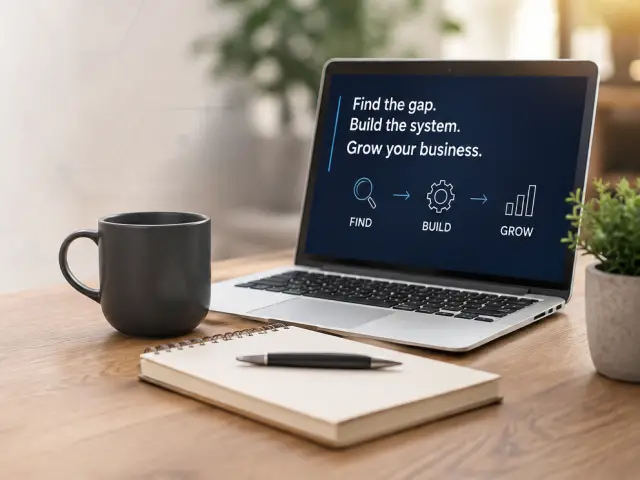
Guest Connecta exists to close these gaps. Our approach is summed up in one line: find the gap, build the system, grow your business.
How the Business Growth Marketplace creates opportunities
The Business Growth Marketplace is the part of Guest Connecta that brings buyers and suppliers together. It focuses on industries where finding a reliable supplier quickly is difficult and where the cost of a wrong choice is high: transport, plant hire, freight, bus hire, vehicle rental, courier services, warehousing, logistics and commercial equipment.
For businesses that need a supplier
A business that needs something moved, hired or sourced sends one request through the Marketplace. The request form asks for the details that matter, such as the service needed, location, dates and specifics, so the brief is complete from the start. We then look for suitable suppliers, check the basics and come back with clear options. The buyer chooses who to work with, and pricing, terms and responsibilities are confirmed in writing before anything is booked.
For a buyer, the benefit is time saved and better decisions. Instead of phoning five companies and comparing five different quote formats, they receive comparable options from one point of contact. We explain this in more depth for two common categories: plant hire brokerage for construction companies and freight brokerage for businesses that do not want to own trucks.
For businesses that supply services
Transport operators, plant owners, carriers, bus companies and other service providers can register as Marketplace suppliers. Registration captures what they offer: services, fleet or equipment, areas served, insurance position and availability. When a request matches, we contact the supplier with the brief and ask whether they can quote.
For a supplier, the benefit is qualified opportunities. The brief arrives with the key details already collected, from a buyer who has asked for help, which means less time spent on vague enquiries and more time quoting on real work. Suppliers decide which requests to quote on and set their own rates.

Partnerships and introductions
Not every opportunity is a single quote. Some of the most valuable opportunities come from businesses working together. Examples include:
- A plant hire company and a transport operator offering a combined package of machine plus delivery to site.
- A courier and a warehousing provider offering storage, pick and pack, and last-mile delivery.
- A bus operator partnering with an events company or a tour operator for recurring trips.
- A small contractor teaming up with a specialist to bid for a larger project.
Through the Business Partnerships category of the Marketplace, businesses can tell us what kind of partner they are looking for. Where we see a sensible fit between businesses in our network, we can make an introduction. As with every introduction, each business makes its own decisions and agrees its own terms.
Turning opportunities into revenue: the growth system
An opportunity is only valuable if it becomes paid work. This is where Guest Connecta’s growth systems come in. A business growth system is the set of repeatable steps, tools and responsibilities that turns enquiries into customers and customers into repeat business. For a supplier receiving Marketplace requests, or any business receiving enquiries from its own marketing, the core parts are:
A clear way to be found
A complete Google Business Profile, a website that states what you do, where you work and how to contact you, and simple proof of reliability such as photographs of your real fleet, client logos with permission, and genuine reviews.
A complete enquiry form
A short form that collects the details you need to quote. This reduces back-and-forth and speeds up your first response.
A fast first response
A written standard for how quickly every enquiry is acknowledged, and a template that confirms the details, answers the main question and states the next step.
Planned follow-up
A follow-up sequence for every quote: a check that it arrived, a useful reminder, and a final message that makes it easy for the buyer to say yes, no or not yet. Our guide to the lead follow-up system shows how to set this up.
After-job relationship building
A thank-you message, a request for feedback and a review, and a planned check-in about the next job or a referral.
The Business Growth Toolkit contains ready-to-edit templates and checklists for each of these steps, and our Business Growth Automation Systems build the whole system for businesses that prefer it done for them.
Why a connector adds value
Some business owners ask why they would use a connector at all, when they can search online themselves. The answer is the same reason businesses use recruiters, estate agents and procurement specialists: knowledge, time and comparison.
- Knowledge. A connector that works across many requests learns which suppliers are reliable, which operate where, and what fair rates look like.
- Time. Searching, calling, explaining and chasing take hours. A connector does this once, properly.
- Comparison. Options gathered with the same questions are far easier to compare than quotes in different formats.
- Accountability. A connector has an incentive to recommend suppliers who perform well, because its own reputation depends on the results.
For suppliers, a connector is a source of qualified work that complements their own marketing, not a replacement for it.
How to get the most from the Marketplace
If you need a supplier
- Give a complete brief. Include location, dates, quantities, specifications and any site or safety requirements.
- Mention your deadline. If timing is critical, say so.
- Be clear about what matters most. Price, availability, reliability, experience with a particular type of job or a combination.
- Respond to the options promptly. Availability changes quickly in transport and plant hire.
- Share feedback after the job. It helps us improve future matches.
If you are a supplier
- Complete your registration fully. Services, equipment, fleet, areas served and insurance help us match you accurately.
- Keep your availability up to date. Let us know when vehicles or machines are free.
- Reply quickly to requests. A fast, specific quote often wins over a slightly cheaper slow one.
- Quote clearly. State what is included and excluded, such as transport, operator, fuel, minimum hire and waiting time.
- Deliver what you promise. Reliability is what earns repeat introductions.
Is your business ready for more opportunities?
Before you look for more work, check that you can handle it well. Opportunities that are mishandled can damage a reputation faster than no opportunities at all. Ask yourself these questions:
- Can buyers reach you during working hours? If calls go unanswered and messages wait until the evening, decide who covers enquiries when you are busy.
- Do you know your capacity? Keep a simple calendar of when vehicles, machines and people are booked, so you can answer availability questions immediately.
- Can you quote within a day? A standard quote template with your rates, inclusions and terms makes fast, consistent quotes possible.
- Is your paperwork ready? Have your company registration, tax clearance or tax compliance status, insurance certificates, B-BBEE certificate or affidavit where relevant, and safety documents available to send when a buyer asks.
- Do you follow up every quote? If not, start with three simple follow-up messages.
- Do you ask for feedback and referrals? A short message after each job builds repeat business.
If several answers are no, fix those gaps first. The Business Growth Toolkit includes checklists for exactly this kind of review.
Common mistakes when chasing new business
Businesses looking for growth often make the same avoidable mistakes:
- Competing only on price. The cheapest quote wins some jobs, but reliability, speed and clarity win repeat customers and better margins.
- Saying yes to everything. Accepting work outside your area, capacity or expertise leads to late delivery and unhappy customers. It is better to decline politely or refer the job to a partner.
- Vague quotes. A quote that does not state what is included invites disputes later.
- Disappearing after the job. The easiest new work comes from customers who already know and trust you.
- Relying on one source of work. Word of mouth, a single large customer or one platform can dry up suddenly. Build several sources of opportunity, including your own marketing, referrals, partnerships and connectors such as the Marketplace.
A worked example
Imagine a small earthmoving business in Gauteng that owns two TLBs and an excavator. Its work comes mostly from word of mouth, which means busy months followed by quiet weeks with machines standing idle.
The owner registers on the Marketplace as a supplier and, at the same time, tightens the business’s own enquiry process: a proper quote request form on the website, a same-day reply standard and a three-step follow-up for every quote. When a contractor sends a Marketplace request for a TLB in a nearby area, the supplier receives a complete brief, replies quickly with a clear quote, and wins the job. After the job, it asks for feedback and offers availability for the contractor’s next phase.
Neither the introduction nor the improved process alone would have made the difference. Together, they turn one request into a working relationship. The example is illustrative, but it reflects the principle behind everything Guest Connecta does: create the opportunity, then build the system to win it.
Responsible introductions
Connecting businesses carries responsibilities. We check the basics before introducing a supplier, share a buyer’s details only with suppliers relevant to the request, and handle personal information in line with our POPIA Privacy Notice. We are open about how the service works, and if a fee applies to a particular job, we say so upfront. Buyers and suppliers should still confirm insurance, compliance and terms for each job, because they are the ones contracting for the work.
Frequently asked questions
How does Guest Connecta connect businesses with new opportunities?
Through the Business Growth Marketplace, which matches businesses that need transport, plant, freight, equipment and related services with suitable suppliers, and through growth systems that help businesses respond to and convert the opportunities they receive.
What kinds of businesses can use the Marketplace?
Businesses that need transport, plant hire, freight, bus hire, vehicle rental, courier services, warehousing, logistics or commercial equipment, and the suppliers who provide those services. Businesses looking for partnerships can also use the Business Partnerships category.
Do I have to book after sending a request?
No. Sending a request does not commit you to booking. If a fee applies to a specific job, we tell you before you accept any quote.
How do suppliers join?
Suppliers complete the registration form on the Become a Marketplace Supplier page. We review every registration and contact suppliers when a suitable request comes in.
Will joining the Marketplace guarantee more work?
No connector can guarantee work. The Marketplace creates qualified opportunities, and suppliers who respond quickly, quote clearly and deliver reliably give themselves the best chance of winning them.
How can I improve how my business converts opportunities?
Start with a fast first response and planned follow-up for every enquiry. The Business Growth Toolkit includes templates and checklists, and the Business Growth Academy has practical guides on each step.
Your next step
If you need a supplier, send one request through the Business Growth Marketplace. If you supply transport, plant, freight or related services, register as a Marketplace supplier. And whichever side you are on, make sure your business is ready to win the opportunities it is given: read what happens after an enquiry and explore the guides in the Business Growth Academy.
Written by Jacob, Chief Marketing Officer, Guest Connecta (Pty) Ltd. This article is general business information. Each buyer and supplier is responsible for confirming insurance, compliance and terms for the work they agree.