Tag: small business

  • Enquiry-to-Booking Conversion: How to Measure It and Improve It

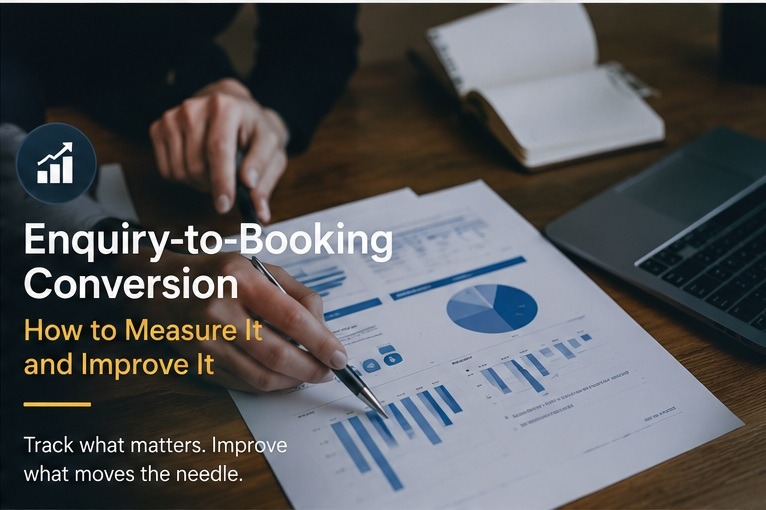
    Enquiry-to-Booking Conversion: How to Measure It and Improve It

    Enquiry-to-booking conversion is the share of enquiries that end in a confirmed booking. You calculate it by dividing the number of confirmed bookings by the number of enquiries over the same period, then multiplying by 100. It is one of the simplest and most useful numbers a booking-based business can track, because it shows whether the work you do to attract enquiries is turning into customers. It has no universal “good” value; the right comparison is your own result, week by week.

    Why this number matters

    Most owners can say how many enquiries they received, and how busy they were, but not how many of those enquiries became bookings. Without that, it is hard to tell whether a quieter month came from fewer enquiries or from more of them slipping away. Measuring conversion separates those two problems, so you fix the right one. For why enquiries stall, see why customers enquire but don’t book.

    The formula

    Booking conversion = (confirmed bookings ÷ enquiries) × 100, both counted over the same period (for example, one week or one month).

    Decide what you will count

    The number is only useful if you count the same way every time. Write down your definitions before you start:

    • Enquiry: a new person asking about your service for the first time, by any channel (message, call, form, in person). Count each person once, not each message.
    • Booking: a confirmed appointment or job, agreed with a date. Decide whether a deposit or a written confirmation is required before you count it.
    • Period: a fixed window, such as Monday to Sunday.
    • Edge cases: repeat customers, cancellations and reschedules. A simple rule is to count a returning customer as an enquiry only when they ask for a new booking, and to remove a booking from the count if it is cancelled.

    A simple weekly tally

    You can do this on paper or in a spreadsheet. For each new enquiry, record:

    ColumnWhat to write
    DateWhen the enquiry arrived
    Name or referenceSo you can find it later
    ChannelMessage, call, form, referral, other
    Service asked aboutWhat they wanted
    First reply sentDate and time you answered
    OutcomeBooked, not ready, declined, no reply
    Reason (your best guess)Why it did not book, if it did not

    At the end of the week, count the rows and the bookings, apply the formula, and write the result at the top. After four weeks you will have a baseline of your own.

    A worked hypothetical example

    These numbers are invented to show the arithmetic, not real results or benchmarks. Suppose a small service business records 40 enquiries in a month and 12 of them become confirmed bookings. The conversion is 12 ÷ 40 = 0.3, or 30%. In the next month the business keeps a saved first reply and offers two specific times in every response. If the next month has 36 enquiries and 14 bookings, the conversion is 14 ÷ 36, about 39%. The point is not the percentages themselves; it is that the business can see whether a change helped, using its own data.

    Look beyond the single number

    An overall figure hides patterns. Once you have a few weeks of data, split it:

    • By channel: do enquiries from one source book more often than another?
    • By service: do some services convert better, perhaps because the price or availability is clearer?
    • By reply time: do enquiries answered quickly book more than those answered later? (See how quickly to respond to an enquiry.)
    • By outcome: how many were “not ready” (worth following up later) versus “declined” (a poor fit)?

    Where to look first to improve it

    1. Reply speed and clarity. Late or vague first replies are among the most common causes of stalled enquiries.
    2. The next step. Does every reply end with one clear action and, ideally, specific times?
    3. Follow-up. Do you contact people who have gone quiet? Our booking follow-up guide has templates.
    4. The booking path. How many steps stand between “yes” and a confirmed slot? See how to map your customer journey to draw it out.
    5. Fit. Are you attracting enquiries that were never a match? That affects the number without being a flaw in your process.

    Common measurement mistakes

    • Counting messages instead of people, which makes the conversion look worse than it is.
    • Changing definitions mid-way, so you cannot compare weeks.
    • Mixing time periods, for example counting this week’s bookings against last week’s enquiries.
    • Forgetting cancellations, which makes conversion look better than reality.
    • Chasing someone else’s benchmark. Different businesses, prices and customers produce very different numbers, so improve against your own baseline.

    From tally to system

    A paper tally is a good start. As volume grows, it becomes worth recording enquiries, replies and outcomes automatically, so the number is always current and follow-ups are triggered without relying on memory. That is the kind of working system our Business Growth Automation System packages are built around, and the Business Growth Toolkit includes editable checklists and templates if you want to start on your own. For the wider view of how the pieces fit, read our customer journey optimisation guide.

    Frequently asked questions

    What is a good enquiry-to-booking conversion rate?

    There is no single good number, because it depends on your service, price, how people find you and how you count. Measure your own for a few weeks and aim to improve it steadily rather than chasing a figure from elsewhere.

    Should I count enquiries that were never a fit?

    Track them, but consider recording them as “declined” or “not a fit” so you can look at conversion with and without them. It tells you whether the issue is your process or the quality of enquiries.

    How often should I calculate it?

    Record outcomes daily or weekly and calculate weekly. Review a monthly figure for trends, because a single quiet week can mislead.

    Does a higher conversion rate always mean more income?

    Not necessarily. It depends on the value of the bookings and your capacity. Look at conversion together with the number of enquiries and the revenue per booking.

    Keep reading

    Part of our guide series: Lead and enquiry conversion: a practical guide.

  • Why Customers Enquire but Don’t Book (and 9 Fixes)

    Why Customers Enquire but Don’t Book (and 9 Fixes)

    Customers usually enquire but don’t book because something between the enquiry and the booking is slow, unclear or uncertain: the reply arrives late, the next step is not obvious, a question about price or availability goes unanswered, the booking takes too many steps, or nobody follows up. The good news is that these gaps are usually specific and fixable. You do not need more enquiries first; you need to see where the ones you already get are stalling.

    Enquiring is not the same as deciding

    An enquiry is a question, not a commitment. Someone who messages you is often comparing two or three options, checking whether you are available, and trying to judge whether you are the sort of business they can rely on. A booking happens when the answers they get are quick enough, clear enough and reassuring enough that saying yes feels easy.

    That is why a business can feel busy and still struggle to fill its diary. The activity at the top of the process (messages, calls, form submissions) looks healthy, while the part between the first message and the confirmed booking quietly leaks. If you want the wider picture, our guide to lead and enquiry conversion explains the whole journey, and where businesses lose money in the customer journey shows the usual leak points.

    Nine reasons enquiries stall before the booking

    1. The first reply arrives too late

    Someone who messages three businesses will often favour the one that answers first, simply because they can move on with their plans. If your replies depend on when you next look at your phone, some enquiries will go cold before you answer. See how quickly you should respond to an enquiry for practical response standards.

    Fix: set a reply standard you can actually keep (for example, an acknowledgement the same working day) and use a short saved reply so it takes seconds, not minutes.

    2. The next step is not obvious

    Many replies answer the question and then stop. The customer is left wondering what to do next: call? pick a time? pay a deposit? Uncertainty about the next step is a common reason for silence.

    Fix: end every reply with one clear next step, such as “Reply with the day that suits you and I will hold a slot,” or a single booking link.

    3. Price, availability or what is included is unclear

    If someone cannot tell roughly what it costs, when you are free or what the service includes, they cannot decide, so they wait, and waiting often turns into not booking.

    Fix: give a clear starting point or range where you can, say what is included, and offer two or three specific available times instead of “let me know what works.”

    4. Booking takes too many steps

    Long forms, account creation, back-and-forth about details you could collect later: each extra step is another chance for someone to drop out.

    Fix: ask only for what you need to hold the booking (name, contact, service, preferred time) and collect the rest after it is confirmed.

    5. The booking channel does not match how they enquired

    A customer who contacted you by message may not want to download an app or fill in a long web form; one who phoned may not want an email with a link.

    Fix: let people book in the channel they started in, or at least offer a simple alternative.

    6. They are not sure they can trust you yet

    New customers look for reassurance: who they will be dealing with, what happens if plans change, how you handle their details. Gaps here create hesitation even when the price is right.

    Fix: make your cancellation and rescheduling approach easy to find, say plainly who will serve them, and share genuine examples of your work where you have permission. Only use real feedback; never invent it.

    7. Nobody follows up

    Many customers who meant to book simply got busy. A polite nudge brings some of them back; silence does not. Our guide on why customers go quiet after a quote covers the same pattern, and booking follow-up gives you ready-to-adapt messages.

    Fix: follow up once or twice, politely, and record when you did.

    8. The timing was simply not right

    Some people enquire early while planning. They are not lost; they are not ready yet.

    Fix: ask when they are likely to need the service, note it, and check back around that time instead of treating a “not yet” as a “no.”

    9. The enquiry was never a good fit

    Not every enquiry should become a booking. Some are outside your service area, outside your budget range or not what you offer.

    Fix: be comfortable declining politely, and, if you can, point them somewhere useful. It keeps your tally honest, so you can see the real gaps instead of blaming enquiries that were never going to book.

    How to find which reason is yours

    You do not have to guess. For two weeks, keep a simple list of every enquiry with five columns: date, how it arrived, when you replied, whether it became a booking, and, if not, your best guess at why. At the end you will see patterns: perhaps most lost enquiries arrived in the evening and were answered the next afternoon, or many stopped after you sent a price. If you want to measure this properly, read enquiry-to-booking conversion (how to count and improve it).

    A hypothetical example

    This is an illustration, not a real business or result. Imagine a small salon that receives enquiries through messages and replies to them in the evening. After keeping the two-week list, the owner notices that enquiries received during the day are often answered 8 to 10 hours later, and that replies never include a suggested time. Two changes follow: a saved reply that goes out the same working day, and a line offering two specific appointment times. The owner then compares the next two weeks of the list with the previous two. The numbers will be the salon’s own, which is the point: you learn what works for your business by measuring your own enquiries, not by borrowing someone else’s figures.

    A sensible order to fix things

    1. Reply standard (reason 1), because it affects every enquiry.
    2. A clear next step and specific times (reasons 2 and 3).
    3. A shorter booking path (reasons 4 and 5).
    4. A follow-up routine (reason 7).
    5. Trust details (reason 6), then fit and timing (reasons 8 and 9).

    Where to start this week

    Start the two-week list today. If you would like ready-made tools to do this, the Business Growth Toolkit includes editable checklists and templates you can adapt. If you would rather have replies, reminders and follow-up built into a working system, see the Business Growth Automation System packages, or read about Guest Connecta.

    Frequently asked questions

    Is it normal for many enquiries not to turn into bookings?

    Yes. Some enquiries are never going to book, and some are early or comparing options. The useful question is not “why isn’t everyone booking?” but “which stalled enquiries could I realistically have kept, and what stopped them?”

    Should I offer a discount to win the booking?

    Usually not first. Many stalled enquiries are caused by delay, uncertainty or a missing next step, not price. Fix those before you cut your prices.

    How long should I wait before following up?

    There is no universal rule. A sensible approach is a prompt acknowledgement, a polite check-in after a day or two, and a final friendly message after about a week, adjusted to how your customers buy. Our booking follow-up guide has example wording.

    Do I need booking software to fix this?

    Not at first. Most of the gaps above can be improved with a saved reply, a clear next step and a simple list. Software becomes useful when volume grows and you want reminders and records to happen without relying on memory.

    Keep reading

    Part of our guide series: Lead and enquiry conversion: a practical guide.
  • Why Customers Go Quiet After a Quote, and How to Follow Up

    Why Customers Go Quiet After a Quote, and How to Follow Up

    Customers usually go quiet after a quote because something is unresolved, not because they have said no. They may still be deciding, comparing, waiting for approval, unsure what the price includes, or simply busy. Silence is rarely a clear answer, and it is the most common place where a business loses a customer it has already worked hard to win. This guide walks through the stages between a qualified enquiry and a signed-off sale, shows where customers tend to drop out, and gives you a follow-up approach that stays helpful rather than pushy.

    What silence after a quote usually means

    When a quote goes unanswered, it is tempting to assume the customer lost interest. In practice, the reasons are more varied, and most of them can be influenced:

    • They are still deciding. Quotes often need discussion with a partner, a manager or a finance person.
    • They are comparing. They may have asked several businesses and are waiting for the rest.
    • They do not understand the quote. The scope, the price or the next step is unclear, and asking feels like effort.
    • The timing has shifted. Something else has become more urgent.
    • The quote got buried. It sits in an inbox or a message thread among dozens of other things.
    • They have a concern they have not voiced. Price, trust, risk or fit, left unspoken.

    Only the last of these is a real “no”, and even that can sometimes be addressed if you know what the concern is. The rest are gaps in the process, and a gap can be closed.

    The five stages between enquiry and sale

    It helps to treat the route from a promising enquiry to a confirmed customer as five stages, because each one loses customers in a different way. The table shows what should happen at each stage and a quick check you can run on your own business.

    StageWhat should happenA common leakQuick check
    1. QualificationYou understand the need, the timing and who decidesYou quote without knowing what the customer really wantsDo you ask the same few questions every time?
    2. The quoteThe customer receives a clear, easy-to-accept offerSlow, vague or hard-to-read quotesCould a stranger understand it in one minute?
    3. After the quoteYou follow up on a plan, not on a whimOne email, then silenceWhen did you last chase a quote older than a week?
    4. The decisionConcerns are heard and answeredThe customer is left to resolve doubts aloneDo you know why your last three lost quotes were lost?
    5. The handoverA yes leads straight to a clear next stepAcceptance, then a silent gap before deliveryWhat does a new customer hear in the first 24 hours?

    Stage 1: qualify before you quote

    A quote written without enough information tends to be wrong, vague or too late, and any of those can cause silence. A few well-chosen questions before you quote also show the customer you are listening. They can be asked in a call, a message or a short form. The questions below suit most service businesses; adapt them to yours.

    • What are you trying to achieve, in your own words?
    • When do you need this done, and is that date fixed?
    • Who else is involved in the decision?
    • Have you used a similar service before, and what would you change?
    • Is there a budget range you are working within?

    The aim is not to interrogate the customer. It is to make the quote fit the real need, and to learn early whether the timing or the decision-maker will be an obstacle.

    Stage 2: make the quote easy to say yes to

    A good quote reduces effort. A customer who has to work out what they are being offered will often postpone the decision, and a postponed decision is easy to forget. A simple structure helps:

    1. Their need, restated. One or two sentences in the customer’s own words, so they know you understood.
    2. What is included (and, where it helps, what is not).
    3. The price, with anything that could change it explained.
    4. How long it will take and when you could start.
    5. The next step. One clear action: reply “yes”, pay a deposit, or book a call.

    Speed matters too, but accuracy matters more. Telling the customer when to expect the quote, and then sending it on that day, is better than a rushed quote that needs correcting. Our guide on how quickly to respond to an enquiry covers how to set those expectations.

    Stage 3: follow up after the quote without nagging

    This is the stage most businesses under-serve. The aim of a follow-up is not to push. It is to make it easy for the customer to respond, and to show you are still interested. A plain structure for the first two weeks might look like this, as an example to adapt:

    • Same day: confirm the quote was sent and ask them to tell you if anything is unclear.
    • A few days later: a short check-in that adds something useful, such as an answer to a question customers often ask, or a relevant example.
    • About a week later: ask whether the timing has changed and whether they need anything else to decide.
    • A final message: a polite close-the-loop note that says you will not chase again, and leaves the door open.

    The exact timing depends on your business and on how fast your customers usually decide, so treat these gaps as a starting point and adjust them as you learn. A simple message might read: “Hi [name], I wanted to check that the quote for [project] arrived and made sense. If any part is unclear, or you would like to change something, tell me and I will update it.”

    For a broader sequence that covers the weeks after any enquiry, see what should happen after someone enquires.

    Stage 4: help the customer decide

    Many quotes stall because the customer has a concern that never gets raised. You cannot answer a question you have not heard, so invite it. Ask something like: “Is there anything that would make this an easier decision?” The common concerns are predictable:

    • Price: explain what the price covers, or offer a smaller first step, rather than discounting by reflex.
    • Timing: ask what date would suit them and whether you can plan around it.
    • Trust: explain how the work is done and what happens if something goes wrong. Only offer proof you genuinely have.
    • Comparison: be clear about what makes your offer different, without criticising others.
    • Approval: ask who needs to approve it and whether a short summary would help them.

    Stage 5: do not lose the customer after a yes

    A customer who says yes can still be lost. If acceptance is followed by silence while you get organised, doubt creeps in. A good handover confirms what was agreed, says what happens next and when, names who the customer will deal with, and tells them what you need from them. This is also the moment to record the sale, so that the whole journey can be measured later.

    A hypothetical example

    The numbers below are made up to show the method. They are not from a real business and are not an industry average.

    Imagine a small business that sends 20 quotes in a month and wins 6. The owner assumes the rest said no. When she goes back through the other 14, she finds that 5 never replied after the quote, 4 said they needed more time, 3 had a question that was never answered and 2 chose someone else. Only two of the fourteen were clear losses. The other twelve point to gaps at stage 3 and stage 4: no planned follow-up and no invitation to raise concerns. If a better follow-up recovered even one or two of them, the value would be that customer’s worth to her business, with no extra advertising spend. Whether it would work in practice depends on the business, which is why it is worth counting your own.

    How to find where your own customers drop out

    You do not need software to start. Keep a simple quote log with one row per quote and these columns:

    • date sent and customer name;
    • value of the quote;
    • dates of each follow-up;
    • outcome: won, lost, or still open;
    • if lost, the reason, if you know it.

    After a month, sort the lost and open quotes into four groups: never replied, asked a question that was not answered, needed more time, and chose someone else. The largest group tells you which stage to fix first. If you do not know why they were lost, that is itself a finding, and the fix is to start asking.

    What to keep personal and what to systemise

    The parts of this process that repeat, such as the quote reminder, the follow-up schedule and the confirmation after a yes, are good candidates for a simple system. The conversations that need judgement, such as understanding a concern or adjusting an offer, should stay with a person. Our guide to what a business growth system is explains how process, people and tools fit together.

    Where to go from here

    Start with one step this week: begin the quote log, and put a follow-up date against every open quote. If you would like ready-made tools, the Business Growth Toolkit includes editable checklists, templates and proposals you can adapt to your own process. If you would rather have a follow-up system built for you, see the Business Growth Automation System packages. For the broader picture, read our guide to lead and enquiry conversion.

    Frequently asked questions

    How long should I wait before following up on a quote?

    A short confirmation the same day is reasonable, followed by a check-in after a few days. The right gap depends on how long your customers normally take to decide, so look at how long your won quotes took and use that as a guide.

    How many times should I follow up?

    Enough to be helpful, but not so many that it feels like pressure. A plan of three or four contacts with a clear end, each adding something useful, is a reasonable starting point to adapt.

    Should I lower my price if they go quiet?

    Not as a first response. Silence is more often about clarity, timing or trust than price. Ask what would make the decision easier before changing the offer.

    Keep reading

    Part of our guide series: Lead and enquiry conversion: a practical guide.
  • How to Map Your Customer Journey, Step by Step

    How to Map Your Customer Journey, Step by Step

    A customer journey map is a simple table that lists each step a customer goes through with your business, and records what the customer wants, what you do, who is responsible and how you will know if it has gone wrong. You do not need special software or a design background. A shared spreadsheet is enough. This guide shows you how to build one for a small service business, step by step, with a worked example, so that you can see where customers are dropped, delayed or confused.

    What a customer journey map is, and what it is not

    A customer journey map describes the path one type of customer takes, from first hearing about you to becoming a customer and, where it applies, coming back or recommending you. Its value is that it shows the whole route in one place. Most businesses know their own part of the process well, but few have ever seen it from the customer’s side, or noticed what falls between the steps.

    It is not a sales funnel diagram, which shows how many people drop out at each stage. It is also not a flowchart of internal tasks. It is a plain description of what happens, written so that you can spot the weak points. Our overview of customer journey optimisation explains why this matters. This page is the hands-on part.

    Before you start

    Three decisions make the exercise much easier:

    • Pick one type of customer. A homeowner booking a repair and a company signing a contract take different routes. Map one at a time.
    • Pick one starting point. For most businesses it is the first enquiry. If you also want to map how people find you, add that stage at the front.
    • Use real cases. Pull out the last five customers you won and, if you can, two or three you lost. You will compare your map against what really happened.

    Step 1: list the stages

    Write down the stages in order. Most small service businesses have some version of the ten below. You may not need all of them, and you can combine stages that are handled together.

    StageWhat it covers
    1. AwarenessHow the customer first finds or hears about you
    2. EnquiryThe moment they contact you or leave their details
    3. First responseYour acknowledgement and first reply
    4. QualificationUnderstanding the need, the timing and who decides
    5. Quote or proposalThe offer you send
    6. Follow-upWhat happens while they decide
    7. DecisionTheir yes, no or not yet
    8. Purchase or bookingPayment, contract or confirmed date
    9. OnboardingThe first days after they say yes
    10. Repeat business or referralStaying in touch and asking at the right time

    Step 2: describe each stage in six columns

    For every stage, write six short answers. They turn a vague list into something you can check:

    1. What the customer wants at this point.
    2. What you do.
    3. Who owns it. One named person, even in a team.
    4. How long it should take. A target you can meet on an ordinary busy day.
    5. Where it is recorded. A list, a calendar, an inbox, a tool.
    6. The failure sign. How you would notice that it had gone wrong.

    Here is an example for a made-up small landscaping business. It is a hypothetical illustration, not a real business, and the targets are examples, not recommendations.

    StageCustomer wantsWe doOwnerTargetFailure sign
    EnquiryTo know someone got their messageLog it in the shared list; send an acknowledgementOffice managerSame dayEnquiry found in an inbox days later
    First responseA real answer and a next stepCall or message to book a site visitOffice managerNext business dayNo visit date offered
    QuoteA clear price and scopeSend a written quote after the visitOwnerWithin three days of the visitQuote still unsent after a week
    Follow-upTo feel looked after, not chasedCheck-in on a set scheduleOffice managerDay 3 and day 7An open quote with no follow-up date
    BookingAn easy way to say yesConfirm the date and depositOffice managerSame day as the yesDate not confirmed in writing
    OnboardingTo know what happens nextSend a short “what to expect” messageOwnerWithin 24 hoursCustomer phones to ask what is happening

    Step 3: mark the hand-offs

    The gaps in a customer journey rarely sit inside a stage. They sit between stages, at the point where something passes from one person, tool or day to the next. Draw an arrow between each pair of stages and ask three questions of every arrow:

    • How does the next stage know it should start?
    • Who is responsible for making that happen?
    • What happens if nobody does?

    For example, when a site visit ends, what triggers the quote? If the answer is “the owner remembers”, that arrow is a likely gap. Hand-offs that depend on memory are the ones that fail when the business gets busy.

    Step 4: compare the map with reality

    The first draft of your map describes how you think things work. Now test it. Take each of your last five customers and trace what actually happened, using emails, messages and call notes. For each stage, note when it happened and whether it matched the map. Mark every place where:

    • a stage was skipped or done in a different order;
    • a stage took much longer than your target;
    • the customer had to ask for something or repeat information;
    • nothing happened because nobody realised it was their turn.

    The differences between the map and the cases are your gaps. If you also look at a customer who did not buy, you can often see the exact stage where it went quiet.

    Step 5: look for friction from the customer’s side

    Some gaps are not about missed steps but about effort. Walk through the map as the customer and ask, at each stage:

    • Is it clear what to do next?
    • Do I have to wait without knowing why?
    • Am I being asked for the same information twice?
    • Is anything confusing, such as the price, the scope or the process?
    • Would I feel looked after, or ignored?

    Our article on seven customer journey gaps that could be costing you customers lists the places where these problems most often appear.

    Step 6: choose what to fix first

    You will probably find more gaps than you can fix at once. Give each a quick score for how many customers it affects and how hard it is to fix, then start with the gap that affects many customers and is easy to correct. For many businesses, those are early in the map: a missed acknowledgement, a slow quote, or no follow-up. Fix one, watch what happens for a month and then return to the list. The guide to finding hidden gaps in your business growth system explains how to measure the result.

    Do not stop at the sale

    The last two stages are often missing from the map, because the sale feels like the finish line. Onboarding is where the customer decides whether they made the right choice: a clear welcome, expectations set and a check-in after delivery all help. The final stage, repeat business and referrals, is where a satisfied customer can be invited to come back or recommend you. Asking at a sensible moment, rather than not at all, is a simple step many businesses overlook.

    Common mistakes

    • Mapping the ideal, not the real. Test every map against real customers.
    • Too many stages. If the map covers a page, merge stages until you can see it at a glance.
    • Mapping everything at once. One customer type is enough to start.
    • Never updating it. The map goes stale as the business changes. Review it every few months.
    • Reaching for tools too early. Get the process clear on paper first; software simply repeats what you give it.

    Where to go from here

    Set aside an hour: list your stages, fill in the six columns for the first three, and trace one real customer through them. You will almost certainly find something. If you would like ready-made tools to work from, the Business Growth Toolkit includes editable checklists, templates and proposals. If you would like a system built around your own journey, see the Business Growth Automation System packages, or read about Guest Connecta to see how we work.

    Frequently asked questions

    How long does it take to map a customer journey?

    A first version usually takes an hour or two for one customer type. Testing it against real customers takes longer, but that is where the useful findings come from.

    Do I need software to create a customer journey map?

    No. A spreadsheet or a sheet of paper is enough. Software is helpful later, when the steps are clear and you want reminders and records to happen automatically.

    How is a journey map different from a sales funnel?

    A funnel counts how many people reach each stage. A journey map describes what happens at each stage and what the customer experiences. The two work well together: the map shows what to look at and the numbers show how much it matters.

    Keep reading

    Part of our guide series: Customer journey optimisation for small businesses.

  • How to Stop Chasing Every Customer Yourself

    How to Stop Chasing Every Customer Yourself

    To stop chasing every customer yourself, first find out which of your follow-ups are repeatable, then write down how each one should work, and only then decide what to hand to a reminder, a colleague or a simple system. You are unlikely to remove yourself from the process entirely, and you should not try to. The goal is to stop relying on your memory and your evenings to keep the customer journey moving, so that nothing is lost when you are busy, away or ill.

    Why an owner-dependent process becomes hard to manage

    In a young business, doing everything yourself is sensible. You know every customer, and a personal message is often the best one. The trouble starts when that habit becomes the process. A process that lives in one person’s head has some predictable weaknesses:

    • It depends on memory. A follow-up you meant to send on Tuesday is easy to lose by Thursday.
    • It breaks when you are away. Leave, illness or a long day on site means enquiries wait.
    • It is inconsistent. Some customers get a quick, thoughtful reply and others get nothing, depending on how your week is going.
    • It does not grow. More enquiries means more chasing, with the same number of hours.
    • It uses your best time on routine work. Reminders and status messages crowd out the work that actually needs your judgement.

    None of this means you have done something wrong. It is a stage most owner-run businesses reach, and it can be fixed gradually.

    Where manual chasing usually hides

    Owners often underestimate how much of their week goes on chasing, because it is spread across many small moments. Common places include:

    • replying to and recording new enquiries;
    • sending quotes and following up on them (see why customers go quiet after a quote);
    • confirming bookings and sending reminders;
    • asking customers for documents, details or decisions;
    • chasing unpaid invoices;
    • checking in after a job or delivery;
    • asking for a review or referral.

    Step 1: log everything you chase for one week

    You cannot improve what you cannot see, so for one working week keep a simple log of every customer-facing task you do by hand. For each one, write down:

    • what the task was;
    • what triggered it (a new enquiry, a date, a missing document);
    • roughly how long it took;
    • whether you have done the same thing before;
    • whether it needed your judgement or could have been done from a template.

    Do not try to be perfect. Even a rough list on your phone will show patterns. Many owners find that more of the tasks are repeats than they expected.

    Step 2: sort the tasks

    Once you have the list, sort each task into one of four groups. The table shows what to do with each.

    Type of taskExampleWhat to do
    Identical every time, no judgementConfirming that an enquiry was receivedGood candidate for an automatic message
    Repeats, but needs a personal touchA follow-up after a quoteWrite a template and set a reminder; you add the personal line
    Varies and needs judgementAdjusting an offer for a unique requestKeep it human; write down how you decide
    Rare or one-offA special request from a long-standing customerLeave it alone

    Often the early gains come from the first two rows. The aim is not to automate as much as possible, but to remove the work that never needed you personally.

    Step 3: write a one-page process for your top two tasks

    Pick the two repeating tasks that cost you the most time or are most often forgotten, and write each one on a single page. A useful one-page process answers six questions:

    1. Trigger: what starts it?
    2. Steps: what happens, in order?
    3. Owner: who does it, and who covers for them?
    4. Deadline: how soon after the trigger?
    5. Message: what is the standard wording?
    6. Done when: how do you know it is finished and recorded?

    For example, a process for “after a quote is sent” might say: the trigger is the quote being sent, the steps are a confirmation message the same day and a check-in after three days, the owner is whoever sent the quote, and it is done when the customer replies or the final close-the-loop note is sent. This is only an illustration; write yours to fit your business.

    Writing the process down has a benefit beyond tidiness: it is the thing you can hand to someone else, or turn into a reminder or an automation later.

    Step 4: replace memory with reminders

    The cheapest improvement is to stop relying on remembering. Put every open enquiry and quote somewhere you will see it, with a next-action date against it. That might be a shared spreadsheet, a calendar or a basic customer list. Start with reminders to yourself, because they keep you in control while removing the memory burden. Only later consider messages that go to customers automatically.

    If you want a structure for this, our guide to building a simple lead follow-up system walks through it, and how quickly to respond to an enquiry covers the first-reply standard.

    Step 5: hand tasks to people as well as tools

    Automation is only one way to reduce your load. If you have a colleague, a part-time assistant or a virtual assistant, the one-page process from step 3 is what lets them take over a task without you explaining it again. For a one-person business, the same pages make it easier to do the task quickly, because you no longer have to decide how it is done each time.

    What should stay human

    Some parts of the customer journey are better handled by a person, even when the rest is systemised:

    • conversations about price, scope or a customer’s concerns;
    • complaints and sensitive situations;
    • moments where the relationship matters, such as thanking a long-standing customer;
    • unusual requests that do not fit the standard process;
    • the final call on an important decision.

    A useful test is to ask: would the customer be happy to learn this message was sent automatically? If not, it should come from you.

    A hypothetical example

    This example is made up to show the method; it is not a real client or a result you should expect.

    Imagine an owner who runs a small consulting practice. After a week of logging, she finds fourteen repeated tasks. Six are the same every time, such as acknowledging enquiries and confirming appointments. Five repeat but need her personal voice, such as quote follow-ups. Three need real judgement, such as pricing unusual projects. She writes one-page processes for the quote follow-up and the appointment confirmation, sets reminders for the first and an automatic confirmation for the second, and keeps the pricing conversations to herself. She still handles every conversation that matters, but nothing depends on her remembering to send it.

    What systems can and cannot do

    It helps to be realistic. Reminders and automated messages can keep routine steps from being forgotten, and can give customers a more consistent experience. They cannot understand a customer’s unusual situation, repair a poor process or replace a conversation. A badly written automatic message can also annoy customers, so test each one yourself, and review them from time to time. A system shifts where your time goes; it does not remove your involvement.

    Our explainer on what a business growth system is shows how process, people and tools work together.

    Where to start this week

    Start the one-week log, then write a one-page process for the single task you forget most often. If you would like ready-made tools for that, the Business Growth Toolkit includes editable checklists, templates and proposals you can adapt. If you would rather have the reminders and follow-up built into a working system, see the Business Growth Automation System packages, or read about Guest Connecta to see how we approach it.

    Frequently asked questions

    Will automation mean I no longer have to follow up with customers?

    No. It can handle repeatable steps and reminders, but conversations that need judgement should stay with you or your team. The aim is fewer things forgotten, not no involvement.

    What should I automate first?

    Start with the simplest, safest step: an automatic acknowledgement of a new enquiry, and reminders to yourself about open quotes. They save effort without putting words in your mouth.

    I am a one-person business. Is this still relevant?

    Yes. Written processes and reminders help you work faster and keep things consistent, and they make it possible to hand tasks over later if the business grows.

    Keep reading

    Part of our guide series: What is a business growth system?.

  • Where Small Businesses Lose Money in the Customer Journey

    Where Small Businesses Lose Money in the Customer Journey

    Small businesses usually lose money at the hand-offs in the customer journey, not at the start of it. The customer is interested, the enquiry has arrived, and then something small goes wrong: it is never recorded, the reply is slow, nobody follows up, the quote stalls, the booking is awkward, or nothing happens after the sale. This guide describes six of the most common places revenue leaks away, how to spot each one and a simple way to estimate what your own leakage might be, using only your own numbers.

    What revenue leakage means

    Revenue leakage is money you would have earned if a customer who was interested had been handled differently. It is not lost because of a bad product or a high price. It is lost in the gaps between steps. The customer wanted to buy, and the process let them slip away.

    Leakage is hard to see because it is made of things that did not happen: the reply that was not sent, the follow-up that was not scheduled, the customer who never came back. That is why a simple count of what actually happens, even by hand, is so useful.

    Leak 1: enquiries that are never captured

    The symptom: enquiries arrive through several places (phone, email, messages, social media, forms) and nobody has a complete list.

    Why it costs money: an enquiry that is not recorded cannot be followed up, measured or learned from. Some are simply forgotten.

    The simplest fix: one list, kept by one person or shared by the team, where every enquiry is written down the same day, whichever way it arrived.

    Leak 2: slow or unclear first replies

    The symptom: some enquiries are answered quickly and others wait days; replies do not say what happens next.

    Why it costs money: people often ask several businesses at once, and the first clear reply tends to win the conversation.

    The simplest fix: a written response standard with a named owner. Our guide on how quickly to respond to an enquiry shows how to set one.

    Leak 3: no follow-up

    The symptom: an enquiry gets one reply and then silence, unless the customer chases.

    Why it costs money: many people who do not answer straight away are still deciding. Without a follow-up, they drift to whoever stays in touch.

    The simplest fix: a short, planned follow-up sequence with a clear end. See what should happen after someone enquires and how to build a simple lead follow-up system.

    Leak 4: quotes and proposals that stall

    The symptom: quotes take a long time to send, are hard to understand, or are sent and never discussed again.

    Why it costs money: a customer who is ready to decide waits, loses momentum or compares with someone who made it easier.

    The simplest fix: a standard quote template, a target for how quickly quotes go out, and a scheduled follow-up after each one.

    Leak 5: friction at booking or payment

    The symptom: customers say yes, but the booking or payment step is slow, confusing or requires too many steps.

    Why it costs money: a customer who has decided can still be lost if the final step feels like work.

    The simplest fix: go through the booking or payment process yourself as a first-time customer. Count the steps, note every point of confusion and remove the ones that do not need to be there.

    Leak 6: nothing after the sale

    The symptom: once the customer has paid, communication stops until something goes wrong.

    Why it costs money: customers who are not welcomed, informed or checked on are less likely to come back or recommend you.

    The simplest fix: a short welcome message that sets expectations, a check-in after delivery, and a polite request for a referral or review at the right time.

    How to estimate your own leakage

    You can put a rough number on your own leakage using four figures from your own business. Use real numbers, even approximate ones. Do not borrow figures from elsewhere.

    1. Enquiries per month (E): how many people contact you.
    2. First replies on time (R): how many of those get a reply within your target time.
    3. Customers won per month (C): how many become customers.
    4. Average value of a customer (V): what an average new customer is worth to you.

    Start with the simplest question: what share of enquiries become customers (C divided by E)? Then look at what happens to the enquiries that did not become customers. How many were never replied to, never followed up or never given a clear next step? Even a small improvement in the share that become customers, multiplied by your average customer value, gives you a rough value for fixing that gap.

    For example, using made-up numbers: if you receive 30 enquiries a month, win 3, and an average customer is worth R5,000 to you, then winning one more customer a month through a better follow-up is worth about R5,000 a month. This example is hypothetical and only shows how to do the sum; your figures will differ.

    The aim is not precision. It is to see which leak is worth fixing first.

    Where to start

    Walk through the six leaks above and tick the ones that sound familiar. Pick the one that affects the most customers and is quickest to fix, usually one of the first three. Fix it, measure for a month and move on to the next. Our guide to customer journey optimisation explains how to rank fixes by impact and effort, and how to find the hidden gaps in your business growth system provides a simple self-audit. Seven customer journey gaps that could be costing you customers lists more places gaps hide.

    If you would like ready-made tools, the Business Growth Toolkit includes editable checklists, templates and proposals you can adapt to your own process. If you would like a system built for you, see the Business Growth Automation System packages.

    Frequently asked questions

    How do I put a number on lost enquiries?

    Count enquiries and customers for a month, then look at the enquiries that did not become customers and note why. Multiply the improvement you could realistically make by your average customer value. The result is a rough guide, not an exact figure.

    Which leak is usually the biggest?

    It depends on the business. For many, the early steps (capturing the enquiry, replying quickly and following up) matter most, because they affect every enquiry. Your own count will show you.

    Do I need software to track this?

    No. A shared spreadsheet is enough to begin. Software becomes useful once the steps are clear and you want reminders and records to happen automatically. What is a business growth system? explains how process, people and tools fit together.

    Keep reading

    Part of our guide series: Customer journey optimisation for small businesses.

  • What Should Happen After Someone Enquires? A Simple Timeline

    What Should Happen After Someone Enquires? A Simple Timeline

    Five things should happen every time someone enquires: the enquiry is acknowledged, recorded in one place, given an owner, answered with a clear next step, and followed up on a set schedule until the person says yes or no. Most businesses do the first one and drop the rest. This guide shows what should happen in the first hour, the first day, the first week and the first fortnight, so you can write it down and make it routine.

    Why the period right after an enquiry matters

    When someone enquires, they have just told you they are interested. They have also probably told one or two of your competitors. Whatever happens next decides whether the conversation continues or quietly ends. Because they have already reached out, this is the cheapest moment in the whole customer journey to win or lose a customer: the marketing has been paid for, and what remains is how you handle the person.

    The trouble is that this period is usually handled by habit rather than process. A reply goes out when someone has time. A follow-up happens when someone remembers. Nobody can say afterwards which enquiries were answered and which were forgotten. A simple timeline fixes this by deciding in advance what happens, when and who does it.

    If you want the bigger picture first, read our guide to lead and enquiry conversion. This article focuses on the timeline itself.

    The first hour: acknowledge, record, assign

    Three small jobs belong in the first hour of every enquiry, even if the full answer takes longer.

    • Acknowledge. Send a short message that thanks the person, confirms what they asked about and says when they will hear from you. This can be written once and reused. It tells them the enquiry arrived and that a real business is on the other end.
    • Record. Write the enquiry down in one place: name, contact details, what they asked, where it came from and the date. One shared list or spreadsheet is enough. If enquiries live only in inboxes, phones and notebooks, some will be lost.
    • Assign. Decide who owns this enquiry. Without a named owner, everyone assumes someone else is dealing with it.

    These three jobs cost a few minutes. They are also the ones most often skipped when a business is busy.

    The first day: understand the need and give a clear next step

    Within the first day, send a proper reply. A good first reply does two things: it shows you understood what the person asked, and it makes the next step obvious.

    To understand the need, ask a small number of well-chosen questions rather than a long form. Two or three questions that show you have read their message are better than ten that make them repeat themselves. If you can answer their question directly, do so, and then offer the next step.

    The next step should be specific. “Let me know if you are interested” leaves all the work to the customer. “Reply with a time that suits you for a short call this week” or “Here is how booking works and what it costs” gives them something to do. Our guide to how quickly you should respond to an enquiry goes deeper on setting a response standard that fits your business.

    Days two to five: follow up with something useful

    If you have not heard back, a follow-up is not pestering. Most people who go quiet are busy, comparing options or waiting for a better moment. A follow-up that adds something useful keeps your business in their mind.

    Useful might mean answering a question they are likely to have, sharing a short guide, or describing how your process works so the next step feels less uncertain. Avoid a message that only says “just checking in”. It adds nothing and is easy to ignore.

    Decide in advance how many follow-ups you will send and when. Our article on building a simple lead follow-up system gives an example schedule and message templates you can adapt.

    Days six to fourteen: check in, then close the loop

    In the second week, send a short, friendly check-in that makes it easy to answer either way: yes, not now or no. Then close the loop. Tell the person you will stop messaging for now and that they are welcome to come back. This is polite, it protects your reputation, and it often prompts a reply from people who were meaning to answer but had not got round to it.

    Closing the loop also helps you. An enquiry with a clear outcome (won, lost, or paused) gives you cleaner numbers than one that simply drifts.

    A one-page checklist

    You can adapt this table into a checklist for your team. The timings are examples, not rules.

    WhenWhat happensWhoDone?
    Within the first hourAcknowledge the enquiry, record it, assign an ownerNamed owner
    Within the first daySend a personal reply with a clear next stepOwner
    Days 2 to 5Follow up with something useful if there is no replyOwner
    Days 6 to 14Friendly check-in, then close the loopOwner
    When there is an outcomeRecord won, lost or paused, and the reason if knownOwner

    The timeline by channel

    Enquiries do not all arrive the same way. The principle is the same, but the details differ.

    ChannelWatch out forA good habit
    PhoneCalls missed or taken without notesWrite down every call straight after, and return missed calls the same day
    EmailMessages buried in a busy inboxA shared inbox or a rule that flags new enquiries
    Website formAn automatic confirmation that says nothing usefulA confirmation that states what happens next and when
    Messaging apps and social mediaEnquiries scattered across several appsCopy each one into your single list as soon as it arrives

    What to automate and what to keep personal

    Automation is useful for the parts that repeat and do not need judgement: the instant acknowledgement, recording the enquiry in your list, reminding the owner to follow up and sending scheduled follow-up messages. It means nothing depends on memory.

    Keep the human parts human: understanding what the customer needs, answering their specific questions and deciding whether a lead is a good fit. Automate the process, not the relationship. And write the process down before you automate it, because automation makes a clear process faster and an unclear one messier. What is a business growth system? explains how the pieces fit together.

    Common mistakes

    • Replying only to the enquiries that seem most promising.
    • Sending one reply and never following up.
    • Letting each team member handle enquiries in a different way.
    • Leaving the next step vague.
    • Never recording the outcome, so you cannot learn which enquiries were lost and why.

    Where to go from here

    Start small. Write the five steps on one page, agree who owns them and use them for the next ten enquiries. Then look at what happened and adjust. If you would like ready-made starting points, the Business Growth Toolkit includes editable checklists and templates you can adapt to your own process. And if you would like a follow-up system built for your business, see the Business Growth Automation System packages.

    Frequently asked questions

    How soon should I reply to a new enquiry?

    Acknowledge it within the first hour if you can, and send a proper reply within the same business day. The right target depends on your business, so set one you can meet consistently and measure how often you meet it.

    What if they do not answer my follow-up?

    Send a short sequence of follow-ups spread over one to two weeks, then close the loop politely. Stop sooner if the person says they are not interested.

    Should I follow up by phone or by message?

    Use the channel the person used to contact you, and offer another if it helps. Someone who emailed may prefer an email; someone who phoned may welcome a call.

    What counts as an enquiry?

    Any contact where someone shows interest in what you offer: a call, an email, a form submission or a message. If in doubt, treat it as an enquiry and record it.

    Keep reading

    Part of our guide series: Lead and enquiry conversion: a practical guide.
  • How Quickly Should You Respond to a New Enquiry? Setting a Response-Time Standard

    How Quickly Should You Respond to a New Enquiry? Setting a Response-Time Standard

    Reply to a new enquiry as fast as you can do consistently, and write that speed down as a standard. There is no single correct number for every business. What matters is that customers get a quick acknowledgement, a useful first reply within a time you have chosen, and the same experience whether the enquiry arrives on a Monday morning or a Friday evening. This guide shows how to set that standard, cover busy periods and time off, and check that you are meeting it.

    Why speed matters, and why we do not quote a magic number

    People often contact more than one business at the same time. The business that replies first, and replies clearly, usually gets the conversation. A quick reply also tells the customer something about how it will be to work with you: that you are organised, that you care and that they will not be left waiting.

    You will find articles that quote exact conversion figures for reply times. We do not repeat them here, because the effect varies by industry, by what is being bought and by the customer, and we cannot verify the figures for your situation. The honest advice is to set your own target, measure how often you meet it and see what happens to your enquiries over time.

    The three levels of response

    “Responding” means different things, so it helps to separate it into three levels with different targets.

    • Level 1: acknowledgement. A short message confirming the enquiry arrived and saying when to expect a proper answer. This can be sent within minutes, and can be automatic.
    • Level 2: first useful reply. A personal answer that shows you read the enquiry, answers what you can and states the next step. This usually takes longer, such as the same business day.
    • Level 3: full answer or proposal. A detailed quote, booking or recommendation, which may need more information or time.

    Setting a separate target for each level makes the standard realistic. You can promise an acknowledgement in minutes without promising a full proposal in minutes.

    A response standard by channel

    Customers expect different speeds from different channels. A message sent through a messaging app usually implies a faster reply than a form on a website. Here is an example you can adapt.

    ChannelAcknowledgementFirst useful replyNote
    Phone callAnswer, or return the call the same dayDuring the callWrite notes straight after
    Messaging appAs soon as you can, within working hoursSame business daySet an away message outside working hours
    EmailAutomatic confirmationSame business day, or next business day if it arrives lateUse a shared inbox if several people reply
    Website formAutomatic confirmation that states what happens nextSame business daySay what the customer should expect

    These timings are examples, not recommendations for every business. Choose targets that you can meet on an ordinary busy day, not only on a quiet one.

    Out of hours and weekends

    You cannot reply instantly at all hours, and customers generally understand that. What frustrates them is silence. An acknowledgement that sets expectations does most of the work.

    A good out-of-hours message does three things: it confirms the enquiry arrived, says when you will reply, and, if it helps, points to something useful in the meantime. For example: “Thank you for your enquiry. We received it and will reply by the end of the next business day. In the meantime, you can find answers to common questions here.”

    Be honest about your hours and then keep to what you promise. A promise of a next-day reply that is met every time builds more trust than a promise of an instant reply that is met sometimes.

    Who covers when you are away

    A response standard fails the moment the one person responsible is ill, on leave or in a meeting. Decide who covers, and make sure that person can see new enquiries. For a one-person business, this might mean a clear away message and a shorter promise during time off. For a team, it means a shared place where enquiries appear and a simple rule for who picks them up.

    Speed versus quality

    A fast reply that is vague or wrong can be worse than a slightly slower reply that is clear. The first level (acknowledgement) is where speed matters most. The second level (the first useful reply) is where quality matters most. If you feel pressure to rush the second level, shorten the first one: send the acknowledgement quickly and take the time to write a good answer.

    How to track response time with a simple log

    You do not need software to measure this. A shared list with five columns is enough:

    • date and time the enquiry arrived;
    • channel it arrived through;
    • date and time of the acknowledgement;
    • date and time of the first useful reply;
    • outcome (won, lost or paused).

    Once a week, count how many enquiries met your target. If you are missing it often, either the target is too ambitious or something in the process needs to change. This log also feeds the numbers described in our guide to lead and enquiry conversion.

    Message examples

    Acknowledgement: “Thank you for contacting [business name]. We have received your enquiry about [topic] and will reply by [time or day]. If it is urgent, you can reach us on [phone number].”

    First useful reply: “Thank you for your enquiry about [topic]. [Short answer to their question.] The next step is [next step]. Would [option] suit you?”

    Delay notice: “We need a little more time to give you an accurate answer about [topic]. We will come back to you by [day].”

    When automation helps

    An automatic acknowledgement is one of the simplest and most useful automations, because it makes the first level of your standard instant without any extra effort. Automation can also remind you when a reply is overdue. What it cannot do is write a thoughtful first reply or decide who covers when you are away. Write the standard first, then automate the parts that repeat. See what a business growth system is for how process, people and tools fit together.

    Where to go from here

    Pick a target for each of the three levels, write it down, tell everyone who handles enquiries and start the log this week. After a month, look at how often you met it and adjust. The Business Growth Toolkit includes editable templates and checklists that can help you set this up. If you would like the acknowledgement and follow-up built into an automated system, see the Business Growth Automation System packages.

    Frequently asked questions

    Is five minutes a realistic target?

    For an automatic acknowledgement, yes. For a personal reply, it depends on your business and team. Choose a target you can meet on an ordinary busy day, and measure how often you meet it.

    What if I cannot reply the same day?

    Send an acknowledgement that says when you will reply, then keep that promise. A clear, honest timeframe is better than silence.

    Is an auto-reply enough?

    An auto-reply is a good first level, but it is not a substitute for a personal reply. It buys you time and sets expectations; the personal reply is what moves the enquiry forward.

    How do I stay consistent when I am busy?

    Write the standard down, record every enquiry in one place, and use a simple log. Consistency comes from a routine that does not depend on memory or mood. For the full sequence after the first reply, see what should happen after someone enquires.

    Keep reading

    Part of our guide series: Lead and enquiry conversion: a practical guide.
  • 7 Customer Journey Gaps That Could Be Costing Your Business Customers

    7 Customer Journey Gaps That Could Be Costing Your Business Customers

    Most businesses can tell you how many people visited their website last month. Far fewer can tell you what happened to those people afterwards.

    Someone finds you, has a look around, maybe sends a message, and then disappears. It's rarely one dramatic failure. It's usually a small gap in the customer journey, then another, then another, and together they quietly cost you customers you've already worked hard to reach.

    This guide explains what a customer journey is, walks through seven customer journey gaps that show up again and again in small businesses, and shows you how to find and fix them.

    What is a customer journey?

    A customer journey is everything a person goes through from the moment they first hear about you to the moment they buy, and what happens afterwards. It usually includes:

    • Awareness: they find you through search, a referral, social media or an advert.
    • Consideration: they look at your website, read reviews and compare you with others.
    • Enquiry: they contact you or start to book.
    • Decision: they receive a quote or details and choose whether to go ahead.
    • Purchase or booking: they pay, book or sign.
    • After the sale: they receive what they bought, get support, and decide whether to return or recommend you.

    Customer journey optimization simply means looking at each of those steps, finding where people get stuck or give up, and making the path easier. For a small business, that doesn't require an expensive project. It requires honesty about what actually happens.

    Seven customer journey gaps that cost businesses customers

    1. The enquiry-to-response gap

    This is the time between someone reaching out and someone replying. The longer it is, the more likely the person has moved on to a competitor or lost interest. If replies depend on whoever happens to be free, this gap will be wide and unpredictable.

    How to spot it: check the timestamp of the last ten enquiries and compare it with the time of your first reply.

    A simple fix: an automatic acknowledgement, plus a clear same-day reply standard.

    2. The follow-up gap

    Many enquiries don't need persuading; they need a second nudge. If your process ends after one reply or one quote, you're leaving interested people to drift.

    How to spot it: count how many quotes or proposals you sent last month, and how many were followed up.

    A simple fix: schedule one or two polite follow-ups after every quote, and write them once as templates. Our guide to a lead follow-up system shows how.

    3. The sales process gap

    Sometimes people engage but can't tell how buying from you actually works. What happens next? How long does it take? What does it cost? When the process is vague, careful buyers hesitate, and hesitation usually turns into "not now".

    How to spot it: ask a recent customer to describe how they thought the process would go before they bought.

    A simple fix: publish or share a short "how it works" outline with three or four clear steps.

    4. The communication gap

    Messages arrive in different places: email, WhatsApp, phone, social media. Customers repeat themselves, receive mixed answers or hear nothing between the quote and the job. Inconsistent communication makes even a good business feel disorganised.

    How to spot it: ask, "If a customer messaged us on three different channels this week, would we see it all in one place?"

    A simple fix: decide which channels you'll use, who monitors each, and which updates customers will always receive.

    5. The checkout or booking gap

    For businesses that take bookings or payments online, this gap is where interest turns into money, or doesn't. Forms that are too long, unclear pricing, missing payment options or confusing confirmation pages all cause people to abandon at the last step.

    How to spot it: complete your own booking or checkout on a phone, as if you were a first-time customer. Note every moment of doubt.

    A simple fix: cut fields you don't need, be clear about what happens after paying, and always send a confirmation that says what comes next.

    6. The onboarding gap

    After someone buys, do they know what to do? Businesses often relax once payment is received. But the first days after a purchase shape whether a customer feels confident or wonders if they made a mistake.

    How to spot it: review what a new customer receives in their first week.

    A simple fix: a short welcome message, a clear next step, and a way to ask questions.

    7. The retention gap

    It's usually easier and cheaper to serve a happy customer again than to win a new one, yet many businesses only speak to customers when they want something. Without any follow-up after a job or purchase, repeat business and referrals depend on chance.

    How to spot it: look at how many customers bought from you more than once in the past year.

    A simple fix: a thank-you and check-in after delivery, a review request, and an occasional useful message.

    How to find the gaps in your own customer journey

    You can map your journey in an hour with pen and paper.

    1. Draw the steps. From first contact to repeat purchase, write each step on a card or a line.
    2. Add who is responsible. Next to each step, note who does what. Gaps often appear where the answer is "nobody" or "it depends".
    3. Add the time. How long does each step usually take? Where does the customer wait?
    4. Add the numbers. How many people reach each step, and how many move on?
    5. Mark the leaks. Circle any step where people wait too long, where nobody owns the task, or where many people drop away.
    6. Fix one gap at a time. Start with the leak closest to the money: usually the enquiry-to-response and follow-up gaps.

    If you'd like a structured place to start, the business growth toolkit is designed to help you look at your business from your customer's point of view.

    An illustrative example

    Picture a small accommodation or tour business taking enquiries through a website form. A traveller asks about availability. The owner replies the next morning with prices. The traveller replies with one more question, but that message arrives on a different channel and is missed for two days. By then the traveller has booked elsewhere.

    None of the individual steps was "wrong". The gaps were in the response time, the communication between channels, and the lack of a follow-up. The fix isn't a bigger advertising budget. It's making sure the enquiry, the reply and the follow-up sit in one connected process.

    (This is a hypothetical scenario used to illustrate the idea.)

    These gaps show up in local shops, service businesses and companies serving customers overseas alike. The channels differ, but the steps between "interested" and "customer" are the same.

    When a system helps

    Once you can see your gaps, the next question is how to keep them closed. Manual effort works for a while, but it breaks when you're busy, which is exactly when enquiries arrive.

    That's where customer conversion systems help: automatic acknowledgements, reminders to follow up, a single place to see enquiries, and messages that go out at the right time without you remembering each one.

    Guest Connecta helps businesses find those gaps and build practical systems around them. If you'd like to see what that looks like, take a look at our business growth systems. You can also read about why enquiries don't become customers.

    Conclusion: fix the gaps before you add more traffic

    Customer journey gaps are rarely dramatic, which is why they go unnoticed. But every small gap between interest and purchase is a chance for a customer to quietly leave.

    Map the journey, look for the leaks, and fix the biggest one first. Improving your customer journey often does more for growth than bringing more people to the front door.

    Think there may be gaps in your customer journey? Guest Connecta helps businesses identify where enquiries and customers are slipping away and build practical systems to improve conversion. Take a look at our Business Growth Systems and see where we can help.

    To lay these stages out for your own business, follow our step-by-step guide to mapping your customer journey.

    Frequently asked questions

    What are customer journey gaps?

    They are points between first contact and repeat purchase where customers are delayed, confused or lost, such as slow replies, missing follow-up or unclear next steps.

    How do I improve my customer journey as a small business?

    Start by mapping the steps from first contact to repeat purchase, add who is responsible and how long each step takes, then fix the biggest leak first. Small improvements add up.

    Which gap should I fix first?

    Usually the one closest to the sale: the time it takes to respond to enquiries and whether you follow up. These tend to have the fastest payback.

    Do I need special software to map a customer journey?

    No. Pen and paper or a simple spreadsheet is enough. Software becomes useful when you want to automate reminders and messages.

    Is customer journey optimization only for online businesses?

    No. Any business with enquiries, quotes, bookings or repeat customers has a customer journey, whether it operates locally or internationally.

    Not sure where your own customers slip away? Find the gaps in your customer journey with Guest Connecta.

    Part of our guide series: Customer journey optimisation for small businesses.

Jacob, Chief Marketing Officer at Guest Connecta

JacobChief Marketing Officer