
When growth slows down, the instinct is almost always the same: we need more leads. More advertising, more posts, more visitors.
Sometimes that's true. But often the business already has more interest than it's converting, and the real problem is somewhere between "someone showed interest" and "someone became a customer". Adding traffic to a system with leaks just means more people fall through the same holes.
This guide shows you how to find the hidden gaps in your business growth system, using numbers you probably already have, and how to fix them before you spend more on getting attention.
What is a business growth system?
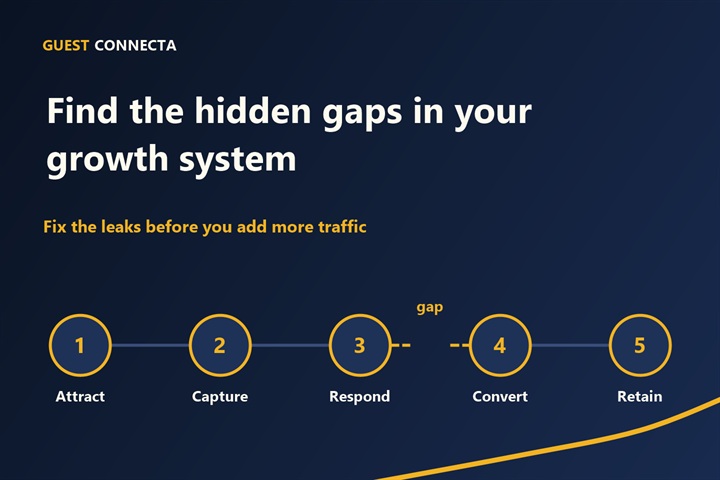
A business growth system is the set of repeatable steps that turns attention into customers and customers into repeat business. Most small businesses already have one, even if it isn't written down:
- Attract: how people find you.
- Capture: how their interest is recorded, through a form, call, message or booking.
- Respond: how quickly and clearly you reply.
- Convert: how enquiries become quotes, bookings or sales.
- Retain: how customers are looked after, and how they return or refer others.
A gap in any of these steps weakens the whole chain. The trouble is that gaps are rarely visible, because we naturally look at the parts we enjoy, like marketing, and overlook the plumbing behind them.
Why fix the leaks before you increase traffic
Imagine pouring water into a bucket with holes. Pouring faster helps a little, but patching the holes helps far more, and costs far less.
The same applies to business growth strategy. If half of your enquiries never get a reply within a day, doubling your leads gives you double the unanswered messages. Fixing the response process improves every lead you already receive, and every lead you'll receive in future.
That doesn't mean you should stop marketing. It means you should know where your system is leaking first, so extra effort actually pays off.
Step 1: Map where customers come from and where they go
Write down the path a typical customer takes, in plain words. For example:
- Finds us through search or a referral.
- Visits the website or messages us.
- Sends an enquiry.
- Receives a reply and possibly a quote.
- Decides.
- Buys or books.
- Receives the product or service.
- Hears from us afterwards, or doesn't.
Then note beside each step who is responsible and where the information is recorded. Wherever the answer is "nobody" or "we don't record it", you've found somewhere to look more closely.
Step 2: Measure the five numbers that matter
You don't need advanced analytics. Gather these for the last one to three months:
- Enquiries: how many people contacted you or started to book?
- Response time: how long did it usually take to reply to the first message?
- Follow-up: how many enquiries or quotes received at least one follow-up?
- Conversions: how many became customers?
- Repeat business: how many customers bought again or referred someone?
If your records are incomplete, that's a finding in itself. Start tracking now, even in a simple spreadsheet, and you'll have useful data within a few weeks.
Step 3: Look for the biggest drop
Now compare the numbers step by step. The place where the biggest share of people disappear is usually your best opportunity. Here are some common patterns and what they may suggest:
- Many visitors, few enquiries: the website may not make the next step clear, or the offer may be unclear.
- Many enquiries, slow replies: response process or capacity is the issue.
- Fast replies, few quotes accepted: the quote, price presentation or follow-up may need work.
- Good sales, little repeat business: the after-sale experience or communication is missing.
The pattern won't always be exact, but it points you towards where to look.
Step 4: Run a simple growth-system audit
Ask these questions honestly. Answer yes, no or "not sure".
Capture
- Can people contact us in the way they prefer?
- Does every enquiry go to one place where it's recorded?
Response
- Does everyone receive an acknowledgement quickly?
- Does someone own each enquiry until it's resolved?
Follow-up
- Do we follow up on quotes and unanswered messages?
- Do we know which leads are waiting for us, and which we're waiting on?
Conversion
- Is the next step obvious in every message we send?
- Do we know our approximate conversion rate?
Retention
- Do customers know what happens after they buy?
- Do we ask for feedback or reviews?
- Do we contact past customers with anything useful?
Every "no" or "not sure" is a potential gap. Circle the ones closest to revenue, usually response and follow-up, and start there.
If you'd like a guided way to work through this, the business growth toolkit is built to help you review your business from your customer's point of view.
Step 5: Fix one gap at a time
Resist the urge to overhaul everything. Choose the single gap that looks most costly and make a small, specific change:
- Slow response? Set a response standard and add an automatic acknowledgement.
- No follow-up? Write two follow-up messages and add reminders.
- Unclear next step? End every reply with one clear action.
- No tracking? Start recording enquiries and outcomes in one place.
Give the change a few weeks, then look at the numbers again. If they improve, move to the next gap. If they don't, adjust and try again.
Our guides on why enquiries don't become customers and customer journey gaps go into the most common ones in more detail.
An illustrative example
Consider a small professional-services firm that decides it needs more leads and increases its advertising. The number of enquiries goes up, but the number of new clients barely changes.
When the owner finally lists what happens to each enquiry, the picture is clear: replies take two to four days, quotes are sent once and never followed up, and nobody records why people say no. The advertising was working. The system behind it was leaking.
After adding a same-day response standard, a follow-up reminder after each quote, and a simple record of outcomes, the same volume of enquiries starts producing more clients. (This is a hypothetical scenario used to illustrate the idea.)
The same thinking applies whether your customers are local or spread across several countries. Time zones and channels differ, but the chain from attention to customer is the same.
When automation can help
Automation is useful once you know what needs automating. Good candidates are repetitive tasks that are easy to forget:
- Acknowledging new enquiries instantly.
- Reminding you to follow up.
- Sending scheduled check-ins and confirmations.
- Collecting reviews after a job.
- Showing you, in one place, what's waiting.
Bad candidates are anything that needs judgement or empathy. Keep those human. And don't automate a broken process: fix the gap first, then automate the fix.
This is exactly what we help with at Guest Connecta: finding where customers are slipping away, then building practical systems that close those gaps. You can see what that involves in our business growth systems, or start on our homepage to see how we work.
Conclusion: build the business growth system before you scale it
A stronger business growth system starts with knowing where you lose people today. Map the journey, measure the few numbers that matter, audit the gaps, and fix them one at a time. Then, when you do invest in more traffic, every new lead has a better chance of becoming a customer.
Find the gap. Build the system. Grow your business.
Think there may be gaps in your customer journey? Guest Connecta helps businesses identify where enquiries and customers are slipping away and build practical systems to improve conversion. Take a look at our Business Growth Systems and see where we can help.
Frequently asked questions
How do I find the gaps in my business?
Map the path a customer takes from first contact to repeat purchase, measure the numbers at each step, and look for the biggest drop. Common gaps are slow replies, missing follow-up, unclear next steps and no after-sale communication.
Should I get more leads or fix my conversion first?
Usually fix conversion first, or at least alongside. More leads into a leaky process means more lost opportunities. Improving the process makes every future lead more valuable.
What numbers should I track for small business growth?
Start with enquiries received, response time, follow-ups sent, customers won and repeat customers. Simple monthly totals are enough to see patterns.
When should I automate parts of my business?
Once you know which steps are repetitive and reliable, such as acknowledgements, reminders and confirmations. Fix the process first, then automate it.
Does a business growth strategy differ for international businesses?
The principles are the same: attract, capture, respond, convert and retain. What changes are the channels, time zones and expectations of your customers.
Part of our guide series: What is a business growth system?.
