Tag: lead follow-up

  • What Should Happen After Someone Enquires? A Simple Timeline

    What Should Happen After Someone Enquires? A Simple Timeline

    Five things should happen every time someone enquires: the enquiry is acknowledged, recorded in one place, given an owner, answered with a clear next step, and followed up on a set schedule until the person says yes or no. Most businesses do the first one and drop the rest. This guide shows what should happen in the first hour, the first day, the first week and the first fortnight, so you can write it down and make it routine.

    Why the period right after an enquiry matters

    When someone enquires, they have just told you they are interested. They have also probably told one or two of your competitors. Whatever happens next decides whether the conversation continues or quietly ends. Because they have already reached out, this is the cheapest moment in the whole customer journey to win or lose a customer: the marketing has been paid for, and what remains is how you handle the person.

    The trouble is that this period is usually handled by habit rather than process. A reply goes out when someone has time. A follow-up happens when someone remembers. Nobody can say afterwards which enquiries were answered and which were forgotten. A simple timeline fixes this by deciding in advance what happens, when and who does it.

    If you want the bigger picture first, read our guide to lead and enquiry conversion. This article focuses on the timeline itself.

    The first hour: acknowledge, record, assign

    Three small jobs belong in the first hour of every enquiry, even if the full answer takes longer.

    • Acknowledge. Send a short message that thanks the person, confirms what they asked about and says when they will hear from you. This can be written once and reused. It tells them the enquiry arrived and that a real business is on the other end.
    • Record. Write the enquiry down in one place: name, contact details, what they asked, where it came from and the date. One shared list or spreadsheet is enough. If enquiries live only in inboxes, phones and notebooks, some will be lost.
    • Assign. Decide who owns this enquiry. Without a named owner, everyone assumes someone else is dealing with it.

    These three jobs cost a few minutes. They are also the ones most often skipped when a business is busy.

    The first day: understand the need and give a clear next step

    Within the first day, send a proper reply. A good first reply does two things: it shows you understood what the person asked, and it makes the next step obvious.

    To understand the need, ask a small number of well-chosen questions rather than a long form. Two or three questions that show you have read their message are better than ten that make them repeat themselves. If you can answer their question directly, do so, and then offer the next step.

    The next step should be specific. “Let me know if you are interested” leaves all the work to the customer. “Reply with a time that suits you for a short call this week” or “Here is how booking works and what it costs” gives them something to do. Our guide to how quickly you should respond to an enquiry goes deeper on setting a response standard that fits your business.

    Days two to five: follow up with something useful

    If you have not heard back, a follow-up is not pestering. Most people who go quiet are busy, comparing options or waiting for a better moment. A follow-up that adds something useful keeps your business in their mind.

    Useful might mean answering a question they are likely to have, sharing a short guide, or describing how your process works so the next step feels less uncertain. Avoid a message that only says “just checking in”. It adds nothing and is easy to ignore.

    Decide in advance how many follow-ups you will send and when. Our article on building a simple lead follow-up system gives an example schedule and message templates you can adapt.

    Days six to fourteen: check in, then close the loop

    In the second week, send a short, friendly check-in that makes it easy to answer either way: yes, not now or no. Then close the loop. Tell the person you will stop messaging for now and that they are welcome to come back. This is polite, it protects your reputation, and it often prompts a reply from people who were meaning to answer but had not got round to it.

    Closing the loop also helps you. An enquiry with a clear outcome (won, lost, or paused) gives you cleaner numbers than one that simply drifts.

    A one-page checklist

    You can adapt this table into a checklist for your team. The timings are examples, not rules.

    WhenWhat happensWhoDone?
    Within the first hourAcknowledge the enquiry, record it, assign an ownerNamed owner
    Within the first daySend a personal reply with a clear next stepOwner
    Days 2 to 5Follow up with something useful if there is no replyOwner
    Days 6 to 14Friendly check-in, then close the loopOwner
    When there is an outcomeRecord won, lost or paused, and the reason if knownOwner

    The timeline by channel

    Enquiries do not all arrive the same way. The principle is the same, but the details differ.

    ChannelWatch out forA good habit
    PhoneCalls missed or taken without notesWrite down every call straight after, and return missed calls the same day
    EmailMessages buried in a busy inboxA shared inbox or a rule that flags new enquiries
    Website formAn automatic confirmation that says nothing usefulA confirmation that states what happens next and when
    Messaging apps and social mediaEnquiries scattered across several appsCopy each one into your single list as soon as it arrives

    What to automate and what to keep personal

    Automation is useful for the parts that repeat and do not need judgement: the instant acknowledgement, recording the enquiry in your list, reminding the owner to follow up and sending scheduled follow-up messages. It means nothing depends on memory.

    Keep the human parts human: understanding what the customer needs, answering their specific questions and deciding whether a lead is a good fit. Automate the process, not the relationship. And write the process down before you automate it, because automation makes a clear process faster and an unclear one messier. What is a business growth system? explains how the pieces fit together.

    Common mistakes

    • Replying only to the enquiries that seem most promising.
    • Sending one reply and never following up.
    • Letting each team member handle enquiries in a different way.
    • Leaving the next step vague.
    • Never recording the outcome, so you cannot learn which enquiries were lost and why.

    Where to go from here

    Start small. Write the five steps on one page, agree who owns them and use them for the next ten enquiries. Then look at what happened and adjust. If you would like ready-made starting points, the Business Growth Toolkit includes editable checklists and templates you can adapt to your own process. And if you would like a follow-up system built for your business, see the Business Growth Automation System packages.

    Frequently asked questions

    How soon should I reply to a new enquiry?

    Acknowledge it within the first hour if you can, and send a proper reply within the same business day. The right target depends on your business, so set one you can meet consistently and measure how often you meet it.

    What if they do not answer my follow-up?

    Send a short sequence of follow-ups spread over one to two weeks, then close the loop politely. Stop sooner if the person says they are not interested.

    Should I follow up by phone or by message?

    Use the channel the person used to contact you, and offer another if it helps. Someone who emailed may prefer an email; someone who phoned may welcome a call.

    What counts as an enquiry?

    Any contact where someone shows interest in what you offer: a call, an email, a form submission or a message. If in doubt, treat it as an enquiry and record it.

    Keep reading

    Part of our guide series: Lead and enquiry conversion: a practical guide.
  • How to Build a Simple Lead Follow-Up System That Converts More Enquiries

    How to Build a Simple Lead Follow-Up System That Converts More Enquiries

    You sent the quote on Monday. By Friday you've heard nothing, and by the following week you've half-forgotten it, because new work and new enquiries have taken over. Meanwhile, the person who asked for it may still be deciding.

    That quiet gap is where a lot of sales are lost. Not because the customer said no, but because nobody asked again.

    A lead follow-up system fixes this. It doesn't need to be complicated or robotic. It's a simple, repeatable way of making sure every enquiry is answered, tracked and followed up, whether you handle five leads a week or fifty. This guide shows you how to build one, step by step.

    Why follow-up matters more than most businesses think

    When someone enquires, they're interested but not yet committed. Between the enquiry and the decision, several things can happen:

    • They get busy and forget.
    • They're waiting for the right moment or budget.
    • They're comparing several businesses and haven't chosen.
    • They have a question they haven't asked yet.

    A polite, well-timed follow-up handles all four. It reminds them you exist, answers unspoken questions, and shows that you're organised and reliable, which is exactly what people look for when choosing who to trust.

    Without a process, follow-up depends on memory and mood. It happens when you're quiet and stops when you're busy, which is backwards, because busy periods are when the most enquiries arrive.

    What happens when businesses don't follow up

    The cost is usually invisible, which is why it persists. You don't see the customers who quietly went elsewhere; you only see the ones who stayed.

    Typical effects include:

    • Quotes that go cold with no answer either way.
    • Leads that seemed keen but never replied to a single message.
    • No idea which enquiries are still open.
    • A feeling that marketing "isn't working", when the issue is what happens after the enquiry.

    Improving follow-up is often the fastest way to improve lead conversion, because you're working with people who have already shown interest.

    How to build a simple lead follow-up system

    Step 1: Capture every enquiry in one place

    Before you can follow up, you need to know who to follow up with. Choose a single home for every enquiry, whichever channel it arrives through. This can start as a spreadsheet with these columns:

    • Date received
    • Name and contact details
    • Where they came from (website, phone, referral and so on)
    • What they asked for
    • Current status
    • Next action and date

    If you receive enquiries by phone or WhatsApp, add them to the sheet the same day. The habit matters more than the tool.

    Step 2: Set a response standard

    Decide how quickly you'll respond, and stick to it. A reasonable standard for many small businesses is:

    • An acknowledgement within an hour or two during working hours, even if it only says you've received the message.
    • A full reply by the end of the working day.

    For enquiries that arrive out of hours, an automatic acknowledgement that tells people when to expect an answer keeps the conversation warm.

    Step 3: Define your stages

    Give every lead a status so you always know where things stand. Keep it simple:

    1. New
    2. Contacted
    3. Quote or proposal sent
    4. Following up
    5. Won or lost

    A lead should never sit in a stage without a next action and a date. That single rule stops leads from being forgotten.

    Step 4: Plan the follow-up rhythm

    A simple pattern that works for many businesses is:

    • Same day: acknowledge and answer.
    • Day 2 or 3: check that they received your information and ask whether they have questions.
    • Day 5 to 7: offer something useful, such as an example, a short answer to a common question, or a suggested next step.
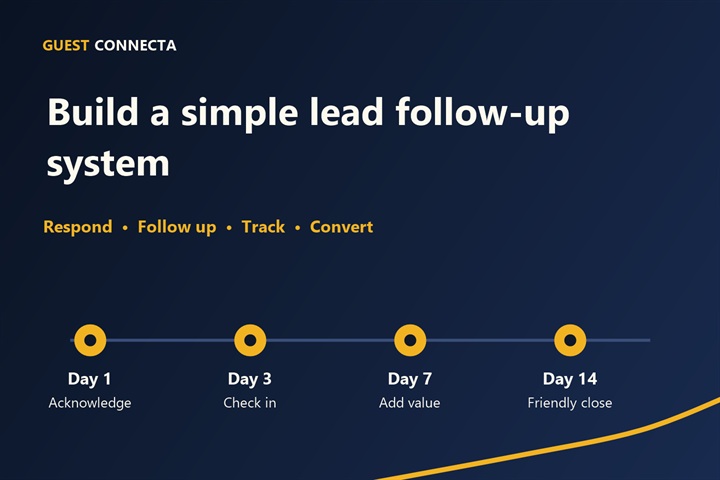
    • Day 10 to 14: a final, friendly check-in that makes it easy to say yes or no.

    Adjust the timing to how long your typical decision takes. A quick service might follow up within days; a larger project might follow up over weeks.

    Step 5: Write the messages once

    Follow-up feels awkward when you write it from scratch each time. Draft a few templates and personalise them. For example:

    • The acknowledgement: "Thanks for getting in touch. We've received your request and will come back to you with details by [time/day]."
    • The check-in: "I wanted to make sure the information I sent came through and to see whether you have any questions."
    • The helpful nudge: "Some people at this stage ask about [common question]. Here's a short answer, in case it helps."
    • The polite close: "I don't want to crowd your inbox, so this is my last note for now. If the timing changes, just reply and we'll pick it up."

    Each message is short, human and easy to answer. None of them are pushy.

    Step 6: Track the results

    Once a week, look at your list and ask:

    • Which leads are waiting for a reply from us?
    • Which are waiting for a decision from them, and when do we follow up?
    • How many enquiries did we receive, and how many became customers?
    • Where do we lose the most people?

    Even simple numbers reveal patterns. If quotes rarely convert, look at your quote and follow-up. If enquiries sit unanswered, look at your response process.

    Step 7: Automate what's repetitive

    Automation is useful for the parts that don't need a human touch:

    • An instant acknowledgement when an enquiry arrives.
    • Reminders to follow up on a set date.
    • Scheduled check-in messages that you can review or personalise.
    • A notification when a lead replies.

    Keep the personal moments human: answering questions, discussing pricing, and building trust. The aim of automation is to remove the forgetting, not the friendliness.

    An illustrative example

    Imagine a consultant who receives a handful of enquiries each week. Before, replies depended on the day. Now, each new enquiry triggers an immediate acknowledgement, a task to reply personally that day, and a reminder three days after any quote is sent. A short check-in message is drafted and ready.

    The consultant's workload barely changes, but no quote is forgotten. Some people reply to the check-in with a question that turns out to be the one thing holding them back. Others say the timing isn't right, and the consultant notes a date to reconnect.

    (This is a hypothetical scenario used to illustrate the idea.)

    The same approach works whether your customers are down the road or in another country. Only the channels and time zones differ, so it helps to state clearly when people can expect a reply.

    Turning follow-up into a repeatable system

    A follow-up system becomes reliable when it stops depending on any single person's memory. To get there:

    1. Write it down. A one-page process: where enquiries are recorded, who replies, how fast, and what the follow-up rhythm is.
    2. Assign an owner. One person is responsible for each lead's next step.
    3. Use templates. So the quality of messages doesn't depend on how busy you are.
    4. Review weekly. A short review keeps the system alive.
    5. Improve over time. Look at which messages get replies and refine them.

    When you're ready to build on that foundation, Guest Connecta helps businesses put practical systems around their enquiries and follow-up. You can see how in our business growth systems, or use the business growth toolkit to review your own process first. If you haven't already, you may also like our article on why enquiries don't become customers and our guide to finding hidden gaps in your growth system.

    Conclusion: a simple lead follow-up system beats good intentions

    Most businesses don't lose leads because they're careless. They lose them because follow-up depends on memory and spare time. A simple lead follow-up system, with one place to record enquiries, a clear response standard, a short follow-up rhythm and a weekly review, turns good intentions into a habit.

    Start small, follow up consistently, and improve as you go.

    Think there may be gaps in your customer journey? Guest Connecta helps businesses identify where enquiries and customers are slipping away and build practical systems to improve conversion. Take a look at our Business Growth Systems and see where we can help.

    If you are the person doing most of the chasing, how to stop chasing every customer yourself shows how to decide what to systemise and what to keep personal.

    Frequently asked questions

    How often should I follow up with a lead?

    Many businesses follow up two to four times over one to two weeks, with each message adding something useful. Adjust the timing to how long your customers usually take to decide.

    What should I say when I follow up?

    Keep it short and helpful: confirm they received your information, offer an answer to a likely question, or suggest a simple next step. Avoid repeating "just checking in" without adding value.

    When should I stop following up?

    When the lead says no, asks you to stop, or you've completed your planned sequence. A polite closing message leaves the door open without pressure.

    Do I need a CRM to follow up with leads?

    Not to begin with. A spreadsheet and saved templates are enough. A CRM or automation tool becomes helpful as volume grows.

    Can follow-up be automated without feeling robotic?

    Yes, if you automate the reminders and acknowledgements and keep the conversations personal. Automation should remove forgetting, not humanity.

    Not sure where your own customers slip away? Find the gaps in your customer journey with Guest Connecta.

    Part of our guide series: Lead and enquiry conversion: a practical guide.

Jacob, Chief Marketing Officer at Guest Connecta

JacobChief Marketing Officer