Tag: business audit

  • How to Map Your Customer Journey, Step by Step

    How to Map Your Customer Journey, Step by Step

    A customer journey map is a simple table that lists each step a customer goes through with your business, and records what the customer wants, what you do, who is responsible and how you will know if it has gone wrong. You do not need special software or a design background. A shared spreadsheet is enough. This guide shows you how to build one for a small service business, step by step, with a worked example, so that you can see where customers are dropped, delayed or confused.

    What a customer journey map is, and what it is not

    A customer journey map describes the path one type of customer takes, from first hearing about you to becoming a customer and, where it applies, coming back or recommending you. Its value is that it shows the whole route in one place. Most businesses know their own part of the process well, but few have ever seen it from the customer’s side, or noticed what falls between the steps.

    It is not a sales funnel diagram, which shows how many people drop out at each stage. It is also not a flowchart of internal tasks. It is a plain description of what happens, written so that you can spot the weak points. Our overview of customer journey optimisation explains why this matters. This page is the hands-on part.

    Before you start

    Three decisions make the exercise much easier:

    • Pick one type of customer. A homeowner booking a repair and a company signing a contract take different routes. Map one at a time.
    • Pick one starting point. For most businesses it is the first enquiry. If you also want to map how people find you, add that stage at the front.
    • Use real cases. Pull out the last five customers you won and, if you can, two or three you lost. You will compare your map against what really happened.

    Step 1: list the stages

    Write down the stages in order. Most small service businesses have some version of the ten below. You may not need all of them, and you can combine stages that are handled together.

    StageWhat it covers
    1. AwarenessHow the customer first finds or hears about you
    2. EnquiryThe moment they contact you or leave their details
    3. First responseYour acknowledgement and first reply
    4. QualificationUnderstanding the need, the timing and who decides
    5. Quote or proposalThe offer you send
    6. Follow-upWhat happens while they decide
    7. DecisionTheir yes, no or not yet
    8. Purchase or bookingPayment, contract or confirmed date
    9. OnboardingThe first days after they say yes
    10. Repeat business or referralStaying in touch and asking at the right time

    Step 2: describe each stage in six columns

    For every stage, write six short answers. They turn a vague list into something you can check:

    1. What the customer wants at this point.
    2. What you do.
    3. Who owns it. One named person, even in a team.
    4. How long it should take. A target you can meet on an ordinary busy day.
    5. Where it is recorded. A list, a calendar, an inbox, a tool.
    6. The failure sign. How you would notice that it had gone wrong.

    Here is an example for a made-up small landscaping business. It is a hypothetical illustration, not a real business, and the targets are examples, not recommendations.

    StageCustomer wantsWe doOwnerTargetFailure sign
    EnquiryTo know someone got their messageLog it in the shared list; send an acknowledgementOffice managerSame dayEnquiry found in an inbox days later
    First responseA real answer and a next stepCall or message to book a site visitOffice managerNext business dayNo visit date offered
    QuoteA clear price and scopeSend a written quote after the visitOwnerWithin three days of the visitQuote still unsent after a week
    Follow-upTo feel looked after, not chasedCheck-in on a set scheduleOffice managerDay 3 and day 7An open quote with no follow-up date
    BookingAn easy way to say yesConfirm the date and depositOffice managerSame day as the yesDate not confirmed in writing
    OnboardingTo know what happens nextSend a short “what to expect” messageOwnerWithin 24 hoursCustomer phones to ask what is happening

    Step 3: mark the hand-offs

    The gaps in a customer journey rarely sit inside a stage. They sit between stages, at the point where something passes from one person, tool or day to the next. Draw an arrow between each pair of stages and ask three questions of every arrow:

    • How does the next stage know it should start?
    • Who is responsible for making that happen?
    • What happens if nobody does?

    For example, when a site visit ends, what triggers the quote? If the answer is “the owner remembers”, that arrow is a likely gap. Hand-offs that depend on memory are the ones that fail when the business gets busy.

    Step 4: compare the map with reality

    The first draft of your map describes how you think things work. Now test it. Take each of your last five customers and trace what actually happened, using emails, messages and call notes. For each stage, note when it happened and whether it matched the map. Mark every place where:

    • a stage was skipped or done in a different order;
    • a stage took much longer than your target;
    • the customer had to ask for something or repeat information;
    • nothing happened because nobody realised it was their turn.

    The differences between the map and the cases are your gaps. If you also look at a customer who did not buy, you can often see the exact stage where it went quiet.

    Step 5: look for friction from the customer’s side

    Some gaps are not about missed steps but about effort. Walk through the map as the customer and ask, at each stage:

    • Is it clear what to do next?
    • Do I have to wait without knowing why?
    • Am I being asked for the same information twice?
    • Is anything confusing, such as the price, the scope or the process?
    • Would I feel looked after, or ignored?

    Our article on seven customer journey gaps that could be costing you customers lists the places where these problems most often appear.

    Step 6: choose what to fix first

    You will probably find more gaps than you can fix at once. Give each a quick score for how many customers it affects and how hard it is to fix, then start with the gap that affects many customers and is easy to correct. For many businesses, those are early in the map: a missed acknowledgement, a slow quote, or no follow-up. Fix one, watch what happens for a month and then return to the list. The guide to finding hidden gaps in your business growth system explains how to measure the result.

    Do not stop at the sale

    The last two stages are often missing from the map, because the sale feels like the finish line. Onboarding is where the customer decides whether they made the right choice: a clear welcome, expectations set and a check-in after delivery all help. The final stage, repeat business and referrals, is where a satisfied customer can be invited to come back or recommend you. Asking at a sensible moment, rather than not at all, is a simple step many businesses overlook.

    Common mistakes

    • Mapping the ideal, not the real. Test every map against real customers.
    • Too many stages. If the map covers a page, merge stages until you can see it at a glance.
    • Mapping everything at once. One customer type is enough to start.
    • Never updating it. The map goes stale as the business changes. Review it every few months.
    • Reaching for tools too early. Get the process clear on paper first; software simply repeats what you give it.

    Where to go from here

    Set aside an hour: list your stages, fill in the six columns for the first three, and trace one real customer through them. You will almost certainly find something. If you would like ready-made tools to work from, the Business Growth Toolkit includes editable checklists, templates and proposals. If you would like a system built around your own journey, see the Business Growth Automation System packages, or read about Guest Connecta to see how we work.

    Frequently asked questions

    How long does it take to map a customer journey?

    A first version usually takes an hour or two for one customer type. Testing it against real customers takes longer, but that is where the useful findings come from.

    Do I need software to create a customer journey map?

    No. A spreadsheet or a sheet of paper is enough. Software is helpful later, when the steps are clear and you want reminders and records to happen automatically.

    How is a journey map different from a sales funnel?

    A funnel counts how many people reach each stage. A journey map describes what happens at each stage and what the customer experiences. The two work well together: the map shows what to look at and the numbers show how much it matters.

    Keep reading

    Part of our guide series: Customer journey optimisation for small businesses.
  • Where Small Businesses Lose Money in the Customer Journey

    Where Small Businesses Lose Money in the Customer Journey

    Small businesses usually lose money at the hand-offs in the customer journey, not at the start of it. The customer is interested, the enquiry has arrived, and then something small goes wrong: it is never recorded, the reply is slow, nobody follows up, the quote stalls, the booking is awkward, or nothing happens after the sale. This guide describes six of the most common places revenue leaks away, how to spot each one and a simple way to estimate what your own leakage might be, using only your own numbers.

    What revenue leakage means

    Revenue leakage is money you would have earned if a customer who was interested had been handled differently. It is not lost because of a bad product or a high price. It is lost in the gaps between steps. The customer wanted to buy, and the process let them slip away.

    Leakage is hard to see because it is made of things that did not happen: the reply that was not sent, the follow-up that was not scheduled, the customer who never came back. That is why a simple count of what actually happens, even by hand, is so useful.

    Leak 1: enquiries that are never captured

    The symptom: enquiries arrive through several places (phone, email, messages, social media, forms) and nobody has a complete list.

    Why it costs money: an enquiry that is not recorded cannot be followed up, measured or learned from. Some are simply forgotten.

    The simplest fix: one list, kept by one person or shared by the team, where every enquiry is written down the same day, whichever way it arrived.

    Leak 2: slow or unclear first replies

    The symptom: some enquiries are answered quickly and others wait days; replies do not say what happens next.

    Why it costs money: people often ask several businesses at once, and the first clear reply tends to win the conversation.

    The simplest fix: a written response standard with a named owner. Our guide on how quickly to respond to an enquiry shows how to set one.

    Leak 3: no follow-up

    The symptom: an enquiry gets one reply and then silence, unless the customer chases.

    Why it costs money: many people who do not answer straight away are still deciding. Without a follow-up, they drift to whoever stays in touch.

    The simplest fix: a short, planned follow-up sequence with a clear end. See what should happen after someone enquires and how to build a simple lead follow-up system.

    Leak 4: quotes and proposals that stall

    The symptom: quotes take a long time to send, are hard to understand, or are sent and never discussed again.

    Why it costs money: a customer who is ready to decide waits, loses momentum or compares with someone who made it easier.

    The simplest fix: a standard quote template, a target for how quickly quotes go out, and a scheduled follow-up after each one.

    Leak 5: friction at booking or payment

    The symptom: customers say yes, but the booking or payment step is slow, confusing or requires too many steps.

    Why it costs money: a customer who has decided can still be lost if the final step feels like work.

    The simplest fix: go through the booking or payment process yourself as a first-time customer. Count the steps, note every point of confusion and remove the ones that do not need to be there.

    Leak 6: nothing after the sale

    The symptom: once the customer has paid, communication stops until something goes wrong.

    Why it costs money: customers who are not welcomed, informed or checked on are less likely to come back or recommend you.

    The simplest fix: a short welcome message that sets expectations, a check-in after delivery, and a polite request for a referral or review at the right time.

    How to estimate your own leakage

    You can put a rough number on your own leakage using four figures from your own business. Use real numbers, even approximate ones. Do not borrow figures from elsewhere.

    1. Enquiries per month (E): how many people contact you.
    2. First replies on time (R): how many of those get a reply within your target time.
    3. Customers won per month (C): how many become customers.
    4. Average value of a customer (V): what an average new customer is worth to you.

    Start with the simplest question: what share of enquiries become customers (C divided by E)? Then look at what happens to the enquiries that did not become customers. How many were never replied to, never followed up or never given a clear next step? Even a small improvement in the share that become customers, multiplied by your average customer value, gives you a rough value for fixing that gap.

    For example, using made-up numbers: if you receive 30 enquiries a month, win 3, and an average customer is worth R5,000 to you, then winning one more customer a month through a better follow-up is worth about R5,000 a month. This example is hypothetical and only shows how to do the sum; your figures will differ.

    The aim is not precision. It is to see which leak is worth fixing first.

    Where to start

    Walk through the six leaks above and tick the ones that sound familiar. Pick the one that affects the most customers and is quickest to fix, usually one of the first three. Fix it, measure for a month and move on to the next. Our guide to customer journey optimisation explains how to rank fixes by impact and effort, and how to find the hidden gaps in your business growth system provides a simple self-audit. Seven customer journey gaps that could be costing you customers lists more places gaps hide.

    If you would like ready-made tools, the Business Growth Toolkit includes editable checklists, templates and proposals you can adapt to your own process. If you would like a system built for you, see the Business Growth Automation System packages.

    Frequently asked questions

    How do I put a number on lost enquiries?

    Count enquiries and customers for a month, then look at the enquiries that did not become customers and note why. Multiply the improvement you could realistically make by your average customer value. The result is a rough guide, not an exact figure.

    Which leak is usually the biggest?

    It depends on the business. For many, the early steps (capturing the enquiry, replying quickly and following up) matter most, because they affect every enquiry. Your own count will show you.

    Do I need software to track this?

    No. A shared spreadsheet is enough to begin. Software becomes useful once the steps are clear and you want reminders and records to happen automatically. What is a business growth system? explains how process, people and tools fit together.

    Keep reading

    Part of our guide series: Customer journey optimisation for small businesses.
  • How to Find the Hidden Gaps in Your Business Growth System

    How to Find the Hidden Gaps in Your Business Growth System

    When growth slows down, the instinct is almost always the same: we need more leads. More advertising, more posts, more visitors.

    Sometimes that's true. But often the business already has more interest than it's converting, and the real problem is somewhere between "someone showed interest" and "someone became a customer". Adding traffic to a system with leaks just means more people fall through the same holes.

    This guide shows you how to find the hidden gaps in your business growth system, using numbers you probably already have, and how to fix them before you spend more on getting attention.

    What is a business growth system?

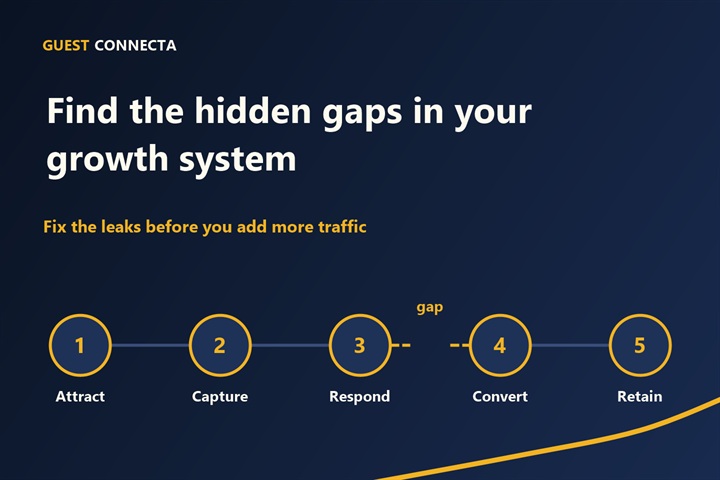
    A business growth system is the set of repeatable steps that turns attention into customers and customers into repeat business. Most small businesses already have one, even if it isn't written down:

    1. Attract: how people find you.
    2. Capture: how their interest is recorded, through a form, call, message or booking.
    3. Respond: how quickly and clearly you reply.
    4. Convert: how enquiries become quotes, bookings or sales.
    5. Retain: how customers are looked after, and how they return or refer others.

    A gap in any of these steps weakens the whole chain. The trouble is that gaps are rarely visible, because we naturally look at the parts we enjoy, like marketing, and overlook the plumbing behind them.

    Why fix the leaks before you increase traffic

    Imagine pouring water into a bucket with holes. Pouring faster helps a little, but patching the holes helps far more, and costs far less.

    The same applies to business growth strategy. If half of your enquiries never get a reply within a day, doubling your leads gives you double the unanswered messages. Fixing the response process improves every lead you already receive, and every lead you'll receive in future.

    That doesn't mean you should stop marketing. It means you should know where your system is leaking first, so extra effort actually pays off.

    Step 1: Map where customers come from and where they go

    Write down the path a typical customer takes, in plain words. For example:

    • Finds us through search or a referral.
    • Visits the website or messages us.
    • Sends an enquiry.
    • Receives a reply and possibly a quote.
    • Decides.
    • Buys or books.
    • Receives the product or service.
    • Hears from us afterwards, or doesn't.

    Then note beside each step who is responsible and where the information is recorded. Wherever the answer is "nobody" or "we don't record it", you've found somewhere to look more closely.

    Step 2: Measure the five numbers that matter

    You don't need advanced analytics. Gather these for the last one to three months:

    1. Enquiries: how many people contacted you or started to book?
    2. Response time: how long did it usually take to reply to the first message?
    3. Follow-up: how many enquiries or quotes received at least one follow-up?
    4. Conversions: how many became customers?
    5. Repeat business: how many customers bought again or referred someone?

    If your records are incomplete, that's a finding in itself. Start tracking now, even in a simple spreadsheet, and you'll have useful data within a few weeks.

    Step 3: Look for the biggest drop

    Now compare the numbers step by step. The place where the biggest share of people disappear is usually your best opportunity. Here are some common patterns and what they may suggest:

    • Many visitors, few enquiries: the website may not make the next step clear, or the offer may be unclear.
    • Many enquiries, slow replies: response process or capacity is the issue.
    • Fast replies, few quotes accepted: the quote, price presentation or follow-up may need work.
    • Good sales, little repeat business: the after-sale experience or communication is missing.

    The pattern won't always be exact, but it points you towards where to look.

    Step 4: Run a simple growth-system audit

    Ask these questions honestly. Answer yes, no or "not sure".

    Capture

    • Can people contact us in the way they prefer?
    • Does every enquiry go to one place where it's recorded?

    Response

    • Does everyone receive an acknowledgement quickly?
    • Does someone own each enquiry until it's resolved?

    Follow-up

    • Do we follow up on quotes and unanswered messages?
    • Do we know which leads are waiting for us, and which we're waiting on?

    Conversion

    • Is the next step obvious in every message we send?
    • Do we know our approximate conversion rate?

    Retention

    • Do customers know what happens after they buy?
    • Do we ask for feedback or reviews?
    • Do we contact past customers with anything useful?

    Every "no" or "not sure" is a potential gap. Circle the ones closest to revenue, usually response and follow-up, and start there.

    If you'd like a guided way to work through this, the business growth toolkit is built to help you review your business from your customer's point of view.

    Step 5: Fix one gap at a time

    Resist the urge to overhaul everything. Choose the single gap that looks most costly and make a small, specific change:

    • Slow response? Set a response standard and add an automatic acknowledgement.
    • No follow-up? Write two follow-up messages and add reminders.
    • Unclear next step? End every reply with one clear action.
    • No tracking? Start recording enquiries and outcomes in one place.

    Give the change a few weeks, then look at the numbers again. If they improve, move to the next gap. If they don't, adjust and try again.

    Our guides on why enquiries don't become customers and customer journey gaps go into the most common ones in more detail.

    An illustrative example

    Consider a small professional-services firm that decides it needs more leads and increases its advertising. The number of enquiries goes up, but the number of new clients barely changes.

    When the owner finally lists what happens to each enquiry, the picture is clear: replies take two to four days, quotes are sent once and never followed up, and nobody records why people say no. The advertising was working. The system behind it was leaking.

    After adding a same-day response standard, a follow-up reminder after each quote, and a simple record of outcomes, the same volume of enquiries starts producing more clients. (This is a hypothetical scenario used to illustrate the idea.)

    The same thinking applies whether your customers are local or spread across several countries. Time zones and channels differ, but the chain from attention to customer is the same.

    When automation can help

    Automation is useful once you know what needs automating. Good candidates are repetitive tasks that are easy to forget:

    • Acknowledging new enquiries instantly.
    • Reminding you to follow up.
    • Sending scheduled check-ins and confirmations.
    • Collecting reviews after a job.
    • Showing you, in one place, what's waiting.

    Bad candidates are anything that needs judgement or empathy. Keep those human. And don't automate a broken process: fix the gap first, then automate the fix.

    This is exactly what we help with at Guest Connecta: finding where customers are slipping away, then building practical systems that close those gaps. You can see what that involves in our business growth systems, or start on our homepage to see how we work.

    Conclusion: build the business growth system before you scale it

    A stronger business growth system starts with knowing where you lose people today. Map the journey, measure the few numbers that matter, audit the gaps, and fix them one at a time. Then, when you do invest in more traffic, every new lead has a better chance of becoming a customer.

    Find the gap. Build the system. Grow your business.

    Think there may be gaps in your customer journey? Guest Connecta helps businesses identify where enquiries and customers are slipping away and build practical systems to improve conversion. Take a look at our Business Growth Systems and see where we can help.

    Frequently asked questions

    How do I find the gaps in my business?

    Map the path a customer takes from first contact to repeat purchase, measure the numbers at each step, and look for the biggest drop. Common gaps are slow replies, missing follow-up, unclear next steps and no after-sale communication.

    Should I get more leads or fix my conversion first?

    Usually fix conversion first, or at least alongside. More leads into a leaky process means more lost opportunities. Improving the process makes every future lead more valuable.

    What numbers should I track for small business growth?

    Start with enquiries received, response time, follow-ups sent, customers won and repeat customers. Simple monthly totals are enough to see patterns.

    When should I automate parts of my business?

    Once you know which steps are repetitive and reliable, such as acknowledgements, reminders and confirmations. Fix the process first, then automate it.

    Does a business growth strategy differ for international businesses?

    The principles are the same: attract, capture, respond, convert and retain. What changes are the channels, time zones and expectations of your customers.

    Part of our guide series: What is a business growth system?.

Jacob, Chief Marketing Officer at Guest Connecta

JacobChief Marketing Officer
